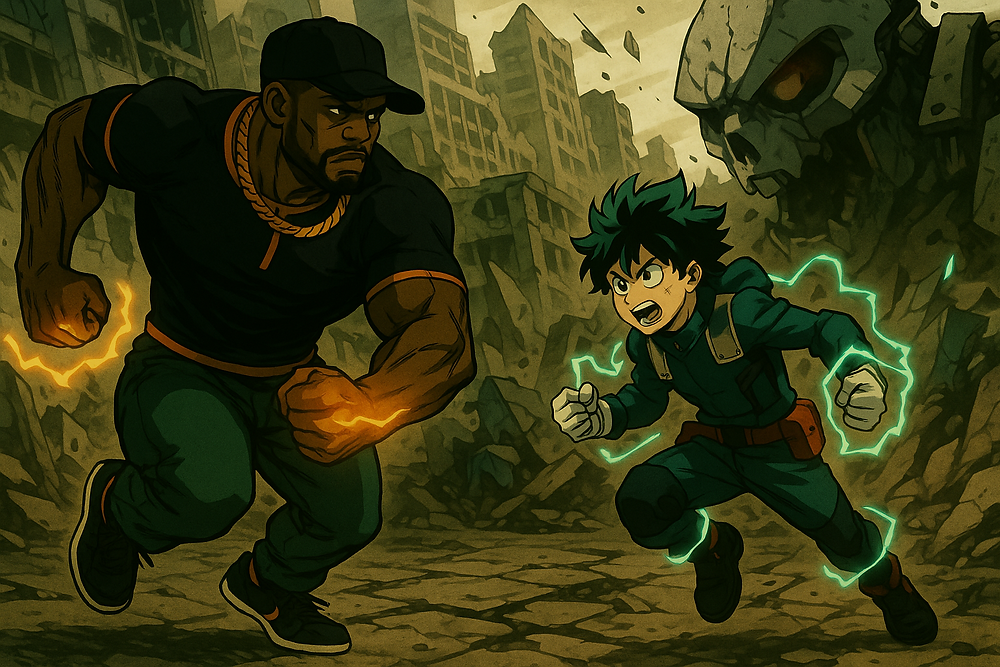
MY HERO ACADEMIA: WHEN TRAINING MEETS INSTITUTIONAL EXCELLENCE — Level IV: Elite Mode
Before you read another word, answer these questions honestly:
What heroic capabilities in your life require systematic development instead of hoping for natural talent?
How does your preference for dramatic breakthroughs prevent you from engaging with disciplined training?
When you imagine greatness, do you see inheritance or cultivation?
What would excellence look like if it required institutional support and structured education?
Five years from now, when you look back at this moment, will you have built capability through systems or waited for convenient power?
What up world, Xavier Savage here from xperformancelab.com.
Hero training without systematic foundation creates reckless power. Hero training WITH institutional discipline creates My Hero Academia—proof that authentic heroism requires capability development through structured education rather than convenient power revelation or emotional breakthroughs.
I’m breaking down why U.A. High School represents the systematic hero development that most superhero content completely ignores. While other hero stories rely on natural talent or dramatic awakening, MHA demonstrates that real heroism demands disciplined training, strategic thinking, and capability cultivation through institutional excellence.
Your body is your first kingdom. Your training is your first hero course. Deku starts with nothing—no quirk, no power, no advantage. He ends as someone who could stand beside the greatest. The difference wasn’t destiny. It was work.
THE XPL ENERGY TIER FRAMEWORK
This post is for Level IV readers. If you’re still waiting for talent to save you instead of training to build you, this analysis will confront you.
XPL PERSPECTIVE FRAMEWORK
MY HERO ACADEMIA RATING BREAKDOWN
Story/Plot Development: Level IV: Elite Mode (🔥🔥🔥🔥/5)
MHA constructs its hero academy narrative like systematic exploration of professional hero development through structured education and disciplined training. Each arc examines how heroic capability requires institutional support rather than natural talent or convenient power awakening.
What the series understands:
-
Power without training is just potential
-
Institutions exist to accelerate development
-
Curriculum creates capability that individual discovery never could
-
Peers provide pressure that teachers cannot
U.A. isn’t just a setting—it’s a development system. Entrance exams, combat training, internships, final exams—every element serves capability cultivation.
XPL Performance Physics: Law 3—Systems Beat Intensity Over Time. Deku doesn’t win through emotional outbursts. He wins through consistent training, strategic application, and institutional support that compounds across seasons.
Savage Command: “Institutions exist because individual discovery takes too long. Learn from those who built systems before you.”
Character Development: Level IV: Elite Mode (🔥🔥🔥🔥/5)
Deku’s evolution from powerless dreamer to strategic hero demonstrates how authentic heroism requires systematic development through disciplined training rather than convenient power inheritance.
His arc:
Phase 1—The Dreamer: Quirkless, written off, still believing. His notebooks aren’t obsession—they’re preparation.
Phase 2—The Inheritance: One For All chooses him. But power given isn’t power mastered. The real work starts here.
Phase 3—The Breaking: His body can’t handle the power. Training isn’t optional—it’s survival. Finger breaks, learning curves, constant failure.
Phase 4—The Strategist: He stops just applying power and starts thinking about it. Shoot style, tactical analysis, opponent study. Intelligence becomes weapon.
Phase 5—The Integration: By the end, he’s not just a power holder. He’s a hero—someone who earned what he was given.
Class 1-A as development laboratory:
-
Bakugo: Talent that needs humility. Power without direction is just destruction.
-
Todoroki: Trauma that needs integration. His arc shows that capability requires healing.
-
Uraraka: Drive that needs channeling. Ambition without strategy burns out.
-
Iida: Discipline that needs flexibility. Rules without adaptation break.
-
Tokoyami: Darkness that needs balance. Power without control consumes.
XPL Performance Physics: Law 2—Identity Precedes Outcome. Deku’s identity as “someone who will be a hero” determines every choice. The power followed the identity, not the reverse.
Identity Mirror: What heroic capabilities in your life require systematic development instead of hoping for natural talent?
Animation/Fight Quality: Level IV: Elite Mode (🔥🔥🔥🔥/5)
Bones delivers superhero animation that serves development themes through spectacular action sequences that demonstrate systematic training results rather than random power displays.
What the visuals communicate:
-
Every technique reflects training, not just power
-
Deku’s finger breaks show the cost of capability without control
-
Bakugo’s explosions are precision, not chaos
-
All Might’s fights are earned, not given
The training sequences: Not filler—foundation. Every exercise, every drill, every failure builds toward later victories.
Training translation: This is what systematic development looks like when it works. Not montages—accumulated competence.
The Chain doesn’t negotiate. Neither should your commitment to training.
Overall Impact/Rewatchability: Level IV: Elite Mode (🔥🔥🔥🔥/5)
MHA rewards analysis like studying systematic development rewards training understanding. Multiple viewings reveal training methodologies and institutional approaches that surface watchers miss.
What rewatching reveals:
-
Early training that later battles reward
-
Character foundations that determine outcomes
-
The institutional systems that enable growth
-
That every victory was prepared for episodes earlier
Savage Command: “Study what rewards rewatch. Development compounds; spectacle fades.”
🔥 FULL ASSAULT: SYSTEMATIC TRAINING VS. TALENT FANTASY
💀 Nuclear Option:
MHA accomplishes what most superhero anime fail at: presenting authentic hero development that requires systematic training and institutional education rather than convenient power awakening.
What the series understands about development:
Principle 1—Institutions accelerate growth.
U.A. compresses decades of trial-and-error into months of curriculum. Deku learns in weeks what solitary discovery would take years to find.
Principle 2—Peers create necessary pressure.
Classmates aren’t just friends—they’re competition. Bakugo pushes Deku. Todoroki challenges everyone. The class dynamic forces growth that solo training never could.
Principle 3—Curriculum requires progression.
First years learn foundations. Second years apply them. Third years specialize. The system is designed to build capability layer by layer.
Principle 4—Failure is diagnostic.
Deku breaks his fingers repeatedly. Each failure teaches something—about his limits, his techniques, his next steps. Failure isn’t defeat—it’s data.
Principle 5—Mentorship multiplies development.
All Might doesn’t just give power. He gives wisdom—years of experience compressed into guidance. Mentorship is force multiplication.
Compare this to typical hero narratives:
-
Superman: Born powerful, never trained
-
Spider-Man: Accident gives power, learns alone
-
Batman: Self-trained, no institutional support
-
Most superheroes: Power arrives, heroism follows
MHA refuses every shortcut. Power must be developed. Training must be structured. Support must be institutional.
The Mirror: What heroic capabilities in your life require systematic development through structured education rather than hoping for natural talent?
The Chain: Your preference for dramatic power moments prevents systematic development. Break the pattern.
⚡ DEEP CUT: DEKU’S PSYCHOLOGY — THE ANALYST WHO BECAME A HERO
Deku’s psychology is what makes him revolutionary.
His baseline:
Quirkless observer: No power meant he had to understand power. His notebooks are survival—knowing heroes because he couldn’t be one.
Analytical mind: He doesn’t just watch—he studies. Fighting styles, techniques, weaknesses, patterns. Information as weapon.
Unshakeable core: “I want to be a hero who saves people with a smile.” This isn’t naivety—it’s identity.
His development:
Phase 1—Knowledge without application: Notebooks full of theory, no way to use it.
Phase 2—Power without control: One For All gives capability he can’t manage. Theory meets practice painfully.
Phase 3—Integration: He starts applying analysis to his own fighting. Shoot style, tactical planning, opponent study.
Phase 4—Mastery: By the end, his mind and his power work together. Analysis informs action. Action feeds analysis.
XPL Application: Your greatest weapon might be your mind. Train it like you train your body.
Bakugo: Talent That Had to Learn Humility
Bakugo represents what happens when natural talent meets its limits.
His psychology:
Gifted from birth: Explosions, power, recognition. He’s always been the best.
Identity crisis: Deku’s rise threatens everything. If a quirkless kid can become competition, what does that say about Bakugo’s talent?
The evolution: He has to learn that power isn’t enough. That technique matters. That others have value. That humility isn’t weakness.
XPL Application: Natural talent without development plateaus. The gifted who refuse to learn get passed by those who never stop learning.
All Might: The Mentor Who Knew His Role
All Might represents what mentorship looks like when it’s done right.
His psychology:
Peak achieved: He reached the summit. Knows what it takes, knows what it costs.
Knowledge to transmit: Not just power—wisdom. Years of experience compressed into guidance.
Willing to step back: The hardest lesson—knowing when to stop being the hero so the next can become one.
XPL Application: The best mentors don’t create followers. They create peers who will surpass them.
⚡ DEEP CUT: WORLD-BUILDING & DEVELOPMENT SYSTEMS
U.A. High School as Development Engine
The school isn’t just setting—it’s system.
What the institution provides:
Structured curriculum: Year one, year two, year three. Each builds on the last. Nothing random, nothing skipped.
Specialized training: Hero courses, support courses, business courses. Different paths for different capabilities.
Practical application: Internships, work studies, provisional license exams. Theory tested under pressure.
Peer ecosystem: Classmates become rivals become allies. The group dynamic forces growth.
XPL Application: Your development needs structure, progression, application, and community. Without these, growth is random.
Quirks as Capability Metaphor
The quirk system isn’t just powers—it’s potential.
What quirks represent:
-
Inherited traits: What you’re born with (natural advantages)
-
Trainable applications: What you develop (cultivated capability)
-
Limitations: What you must work around (constraints)
-
Awakenings: What emerges under pressure (forced adaptation)
The lesson: Your “quirk” is just starting point. Training determines destination.
🔍 SURFACE SCAN: TRAINING/STRATEGY PHILOSOPHY
MHA demonstrates how authentic capability development requires specific approaches that talent fantasy never teaches.
What the series teaches about systematic training:
1. Institutions accelerate growth.
U.A. compresses decades into months. Learn from those who built systems before you.
Application: What institutions could accelerate your development?
2. Peers create necessary pressure.
Classmates push each other. Solo training has ceiling. Group training has none.
Application: Who’s pushing you to grow?
3. Curriculum requires progression.
Foundations before advanced. Theory before application. Each layer builds on previous.
Application: What foundations have you skipped?
4. Failure is diagnostic.
Deku’s broken fingers teach limits and next steps. Failure isn’t defeat—it’s data.
Application: What are your failures teaching you?
5. Mentorship multiplies development.
All Might’s wisdom compresses experience. Mentors give what years would take.
Application: Who’s mentoring you? Who are you mentoring?
6. Power must be developed, not just received.
One For All was given. Mastery was earned. Inheritance is starting point, not finish line.
Application: What have you been given that you haven’t yet earned?
XPL Performance Physics: Law 3—Systems Beat Intensity Over Time. U.A.’s system beats any individual training regimen.
Savage Command: “Institutions exist because individual discovery takes too long. Learn from those who built systems before you.”
🔥 FULL ASSAULT: LEGACY & IMPACT
💀 Nuclear Option:
MHA influenced superhero anime to understand that authentic heroism requires systematic capability development rather than convenient power awakening.
What it accomplished:
Normalized institutional training: Proved that heroes need schools, not just accidents
Demonstrated peer effects: Showed that classmates push growth
Explored mentorship value: All Might as template for knowledge transfer
Respected development time: No shortcuts, no convenient power-ups
The influence:
Every academy-based superhero narrative since owes something to MHA. Its approach to structured development, peer dynamics, and institutional support set standards for the genre.
Savage Command: “Build heroic capability through systematic education and disciplined training. Choose institutional excellence over talent fantasy.”
The Throne: Most people who prefer “naturally gifted” heroes over systematic development are revealing their inability to commit to disciplined capability cultivation. They want results without work.
THE MASTERY SYMBOLS
🔗 The Chain: Your training connects to your capability. Strong system, strong capability. Weak system, weak capability. No exceptions.
🪞 The Mirror: When you watch Deku train while others coast, do you see any reflection of your own work ethic? What are you developing when no one’s watching?
👑 The Throne: How will you build systematic capability through structured education and institutional support instead of waiting for talent to save you?
FINAL STRATEGIC ASSESSMENT
MHA asks questions most narratives avoid:
What if power requires development, not just acquisition?
What if institutions exist for reasons you haven’t appreciated?
What if peers matter as much as teachers?
What if failure is diagnostic, not defeat?
What if you’ve been given something you haven’t yet earned?
Savage Command: “Build heroic capability through systematic education and disciplined training. Choose institutional excellence over talent fantasy.”
Savage Command: “Develop authentic mentorship that provides structured knowledge transfer, not just emotional support.”
Savage Command: “Your starting point is not your destination. Training determines both.”
IDENTITY MIRROR QUESTIONS
What heroic capabilities in your life require systematic development instead of hoping for natural talent?
How does your preference for dramatic power moments prevent you from engaging with disciplined training?
What systematic education approaches do you need for developing authentic capability rather than relying on convenient breakthrough?
When do you choose talent fantasy over systematic development that requires structured training?
Where are you seeking natural talent justification instead of building capability through institutional support?
What foundations have you skipped?
Who’s pushing you to grow?
What have you been given that you haven’t yet earned?
ACTION TRIGGER QUESTIONS
What’s one area where you’ll stop waiting for talent and start building through training this week?
What institution could accelerate your development?
Who’s your peer pressure for growth?
What failure from this week can you treat as data?
Who are you mentoring? Who’s mentoring you?
RESOURCE DROP
Follow my daily insights on Instagram @xperformancelab and YouTube @xperformancelab.
For those in Houston demanding the highest level of training, in-person sessions are available at VFit Gym, 5535 Richmond Ave, Houston, TX.
Elite online training systems at xperformancelab.com.
Take the Archetype Quiz to discover your specific body type protocol: xperformancelab.com/quiz
📊 SEO OPTIMIZATION DATA
Meta Description (155 chars max):
Xavier Savage analyzes My Hero Academia as a masterclass in systematic hero development—and why institutional training beats natural talent every time.
URL Slug:
my-hero-academia-systematic-development-analysis
Primary Keyword:
My Hero Academia systematic analysis
Secondary Keywords:
hero training anime, Deku character analysis, U.A. High School, institutional excellence anime, Xavier Savage anime review
Target Search Intent:
Informational
🖼️ IMAGE OPTIMIZATION GUIDE
Featured Image:
-
File Name: xavier-savage-my-hero-academia-xpl-featured.jpg
-
Alt Text: “Xavier Savage analyzing My Hero Academia systematic hero development at XPerformanceLab”
-
Dimensions: 1200x630px minimum
🎨 MIDJOURNEY VISUAL PROMPTS
Prompt 1: Hero Academy
/imagine prestigious hero training academy campus, students training in various disciplines, heroic atmosphere, morning light, sense of purpose and development, institutional excellence, cinematic composition –ar 16:9 –style raw –v 6
🔗 INTERNAL LINKING STRATEGY
-
Anchor Text: “progressive overload”
-
Anchor Text: “mentorship value”
-
Anchor Text: “systematic capability cultivation”
Inertia Over Inspiration. Always.
Execute.