
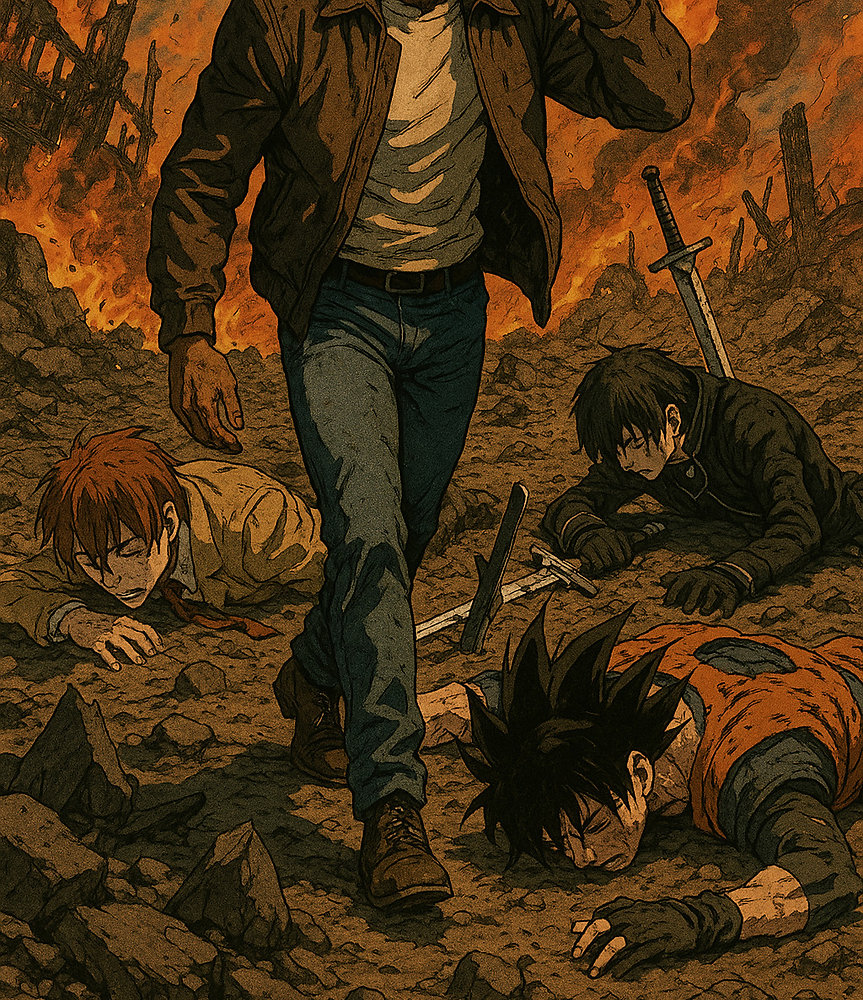
# DRAGON BALL, DEATH NOTE, SWORD ART ONLINE: WHY THESE 3 ANIME ARE OVERRATED — Level IV: Elite Mode
—
**Before you read another word, answer these questions honestly:**
What false narratives about power have you been consuming that keep you weak?
When you imagine strength, do you see earned growth or inherited potential?
Do you idolize intelligence that serves justice—or intelligence that justifies domination?
What real-world challenges are you avoiding by hiding in fantasy simulations?
Five years from now, when you look back at this moment, will you have built your own mythology or just consumed someone else’s?
—
What up world, Xavier Savage here from xperformancelab.com.
They’re everywhere.
*Dragon Ball Z* posters dominate gym walls. *Death Note* quotes litter every self-proclaimed “deep” anime thread. *Sword Art Online* avatars are standard issue in toxic gamer forums.
You’ve seen them. You’ve likely even found yourself drawn to them.
But here’s the truth they don’t want you to understand: They’re not legendary. They’re *loaded*.
These aren’t just popular anime series. They are ideological delivery systems. Soft-coded media weapons designed to condition how you perceive yourself, your culture, your power, and your adversaries.
Each one teaches a distinct lie. Together, they weave a dangerous pattern.
This is the XPL dissection.
**Your body is your first kingdom.** Your mind is your first defense. If you’re consuming propaganda disguised as entertainment, you’re not being entertained—you’re being *programmed*.
—
## THE XPL ENERGY TIER FRAMEWORK
| Level | Focus | Icon | Client State |
|——-|——–|——|————–|
| **Level I: Awareness** | Exposure | 🪞 | “I didn’t know what I didn’t know” |
| **Level II: Activation** | Questioning | ⚡ | “Maybe what I’ve been doing isn’t working” |
| **Level III: Execution** | Deployment | 🛠️ | “I execute regardless of how I feel” |
| **Level IV: Elite Mode** | Mastery | 🔥 | “How can I extract 10% more from this system?” |
| **Level V: Peak Mastery** | Integration | 🧠 | “Discipline is my default setting” |
**This post is for Level IV readers.** If you’re still defending mediocrity because it’s popular, this analysis will confront you.
—
## XPL PERSPECTIVE FRAMEWORK
| Intensity | Icon | Purpose | When To Use |
|———–|——|———|————-|
| 🔍 | Surface Scan | Quick observations | Intro/transitions |
| ⚡ | Deep Cut | Tactical analysis | Main sections |
| 🔥 | Full Assault | Controversial takes | Hot takes/criticism |
| 💀 | Nuclear Option | Destroying sacred cows | Obliterating popular opinions |
—
## THE COMMON THREAD — ESCAPE WITHOUT EVOLUTION
All three series aggressively market the same toxic fantasy: **”You can ascend without accountability.”**
That’s the core blueprint destroying young minds.
In *Dragon Ball*, power is largely inherited—not truly earned. You’re either born with god-tier potential, or you’re not.
In *Death Note*, morality becomes optional if you’re deemed “smart enough.” Intelligence is presented as justification for tyranny.
In *Sword Art Online*, you’re rewarded for isolation and escapism, not for integration and contribution in the real world.
These anime construct systems where growth doesn’t equal genuine transformation, intelligence doesn’t equal empathy or wisdom, and strength doesn’t equal service or responsibility.
They subtly train people to worship hierarchy unquestioningly, simulate morality without internalizing it, and avoid authentic, real-world challenges. They seduce you with the allure of power but condition you to fear depth.
**XPL Performance Physics: Law 3—Process Beats Intensity Over Time.** These shows sell intensity without process, power without price, transformation without work. That’s not growth—that’s *fantasy*.
**Savage Command:** “Real power comes from overcoming real resistance. Everything else is just entertainment.”
—
## THE XPL TRIANGLE — THREE FALSE HERO ARCHETYPES
### 🔥 Full Assault: Goku – The Inherited God
**He teaches:** “If you’re born special, the universe will bend to your will.”
Power is in your bloodline. Wisdom is portrayed as secondary, if not irrelevant. Emotion is often depicted as weakness.
This isn’t a narrative of strength. It’s eugenics wrapped in the guise of martial arts.
**XPL Performance Physics: Law 2—Identity Precedes Outcome.** Goku’s identity as “Saiyan” determines his potential. Your potential isn’t in your blood—it’s in your choices.
—
### 🔥 Full Assault: Light Yagami – The God Complex Savior
**He teaches:** “If you’re intelligent enough, you are justified in controlling everyone else.”
Justice is equated with domination. Guilt becomes a negotiable concept. Mercy is framed as a character flaw.
This isn’t a showcase of intelligence. It’s fascism armed with a supernatural pen.
**XPL Performance Physics: Law 6—Identity Contradiction Creates Homeostatic Resistance.** Light’s identity as “god” conflicts with his humanity. His nervous system should reject this—but the narrative glorifies the contradiction instead of showing its cost.
—
### 🔥 Full Assault: Kirito – The Untouchable Escapist
**He teaches:** “The world is inherently against you until you become overwhelmingly overpowered.”
Emotions are treated as mere accessories. Women are often positioned as rewards or support systems. Pain is presented as largely optional or easily overcome through power-ups.
This isn’t a journey of healing. It’s self-insertion fantasy achieved through simulation.
**XPL Performance Physics: Law 1—Energy Debt Compounds Faster Than Discipline.** SAO protagonists burn emotional energy on fantasy conflicts while accruing real-world debt. The series never shows the crash that follows.
**Savage Command:** “Stop accepting heroes who never truly struggle. Real power comes from overcoming real resistance.”
—
## ⚡ Deep Cut: HOW THEY CONDITION YOU
These narratives are not random. They are meticulously designed to encode specific belief systems.
### Dragon Ball — Hierarchy as Destiny
Conditions you to accept notions of racial superiority and rigid hierarchy. Blonde hair and light eyes (Super Saiyan) equals ascended, god-like status. Certain Black characters historically depicted as caricatures or simplistic. Lineage trumps sustained, intelligent effort.
It frames inherent privilege as undeniable destiny.
**Visual design reveals the agenda:**
– Mr. Popo represents a long-standing, problematic design rooted in minstrel caricature
– Uub is positioned as a tokenized brown-skinned character for redemption arcs
– Super Saiyan transformation idealizes specific light-featured traits as the pinnacle of power
—
### Death Note — Surveillance as Justice
Conditions you to idolize control and systems of surveillance. Intelligence equals the right to dominate. Empathy equals interference or weakness. Women are often relegated to tools or pawns.
It seeks to replace genuine justice with cold, hard judgment.
**Visual design reveals the agenda:**
– Light’s design projects sanitized ‘perfection’—clean-cut, godlike stature
– Misa is hyper-sexualized, a fetishized doll-like figure
– L represents the neurodivergent genius, but portrayed as lacking social grace, reinforcing stereotypes
—
### Sword Art Online — Simulation as Life
Conditions you to escape from failure rather than evolve through its lessons. Virtual world engagement over real-world problem-solving. False achievements within the simulation become core identity. Female characters frequently serve as healing stations or emotional support.
It replaces meaningful struggle with consequence-light simulation.
**Visual design reveals the agenda:**
– Kirito is the generic “cool” male protagonist, a blank slate for self-insertion
– Asuna starts strong but is frequently reduced to a damsel or support role
– Villains are often grotesque, overtly “evil,” sometimes embodying predatory traits
**Savage Command:** “Question every idol. Burn their thrones. Build your own.”
—
## 🔍 Surface Scan: VISUAL COLONIALISM — THE AESTHETIC PROBLEM
Let’s talk about design. In all three series, character aesthetics often reveal the underlying agenda.
Ethnic and female characters are too often objects or plot devices, not agents with their own sovereignty.
Visual design itself becomes a hierarchy: White-passing or specific East Asian aesthetics equal the heroic default. Everyone else equals side quest, background noise, or stereotyped representation.
This is how art can inadvertently become a tool for digital eugenics, subtly reinforcing biased standards of heroism and importance.
**The Mirror:** When you watch these shows, who do you see as hero? Who do you see as background? What does that teach you about who matters?
—
## 🔥 Full Assault: THE BLACK AND BROWN TAKEAWAY
Let’s get brutally honest.
When Black and Brown youth watch these influential shows, we often don’t see authentic reflections of ourselves. Goku’s journey doesn’t typically mirror the experiences of Black fathers. Light’s brand of justice doesn’t resonate with our ongoing struggles for true equity. Kirito’s escapism doesn’t reflect the way we navigate and overcome real-world pain.
But what do we instinctively do? We extract the valuable pieces.
– From Goku: The discipline, the grind, the relentless pursuit of strength
– From Light: The strategic thinking, the vision, the intellectual rigor
– From Kirito: The adaptability, the survival instinct in hostile environments
We salvage meaning from what is often propaganda. But this process still leaves scars.
Because we rarely see our bodies depicted with the same beauty, complexity, or heroism. Our diverse cultures are seldom centered in these mainstream narratives. Our unique pain and resilience are frequently ignored. Our victories, when shown, often feel borrowed or secondary.
**The Chain:** These shows can train us to admire the sword but ignore the historical and cultural context from which it’s drawn. They become digital plantations with sophisticated animation.
**Savage Command:** “Don’t just admire the sword. Forge your own.”
—
## ⚡ Deep Cut: WHO BENEFITS?
This isn’t conspiracy theory. This is understanding strategy.
These anime aren’t just popular because they’re “good” storytelling. They are promoted and achieve widespread appeal because they:
– Reinforce existing power structures and hierarchies
– Reduce complex masculinity to simplistic dominance
– Exclude or marginalize diverse identities
– Train viewers to passively accept societal imbalance
They are the anime equivalents of:
– Billionaire self-help manifestos that ignore systemic issues
– Idealized military recruitment advertisements
– Outdated colonizer mythologies
– AI-generated affirmations for men who harbor resentment toward women
They serve the status quo. And that’s precisely why you encounter them everywhere.
—
## 🔍 Surface Scan: THE SOVEREIGN ALTERNATIVE
Here’s how you, as a discerning individual, can take the power back.
**Ask: Who truly benefits from this fantasy?** If the primary answer is “those already in power,” it’s likely not *your* story.
**Recast the Roles.** Engage in a thought experiment:
– What if Goku was envisioned hailing from a culture whose mythologies and warrior traditions are rarely centered?
– What if Light Yagami was a Black child navigating generational trauma and systemic injustice?
– What if Kirito had to use his coding skills to navigate real-world oppression, not just a virtual game?
**Reject Hierarchy-Based Power.** Stop idolizing characters who win primarily because of birthright, prophecy, or unearned power-ups.
**Study Characters Who Evolve Through Failure and True Struggle.** Seek out narratives featuring sovereign characters:
– Yusuke Urameshi (*Yu Yu Hakusho*)
– Kazuma Kuwabara (*Yu Yu Hakusho*)
– Michiko Malandro (*Michiko & Hatchin*)
– Spike Spiegel (*Cowboy Bebop*)
These are sovereign characters. They lose. They bleed. They make mistakes. They grow. They don’t just dominate their worlds; they survive them—and often, transcend them with genuine depth.
**Savage Command:** “Build your own mythology. Stop consuming other people’s power fantasies.”
—
## 💀 Nuclear Option: THE SAVAGE VERDICT
*Dragon Ball*, *Death Note*, and *Sword Art Online* are not timeless classics deserving of unquestioning praise.
They are colonial frameworks repackaged as mass entertainment.
They teach young men, in particular, to chase domination rather than depth. They often present trauma without meaningful pathways to healing. They romanticize savior complexes and erase the power of community and collective action.
They effectively sell oppression back to you… accompanied by a catchy theme song.
They feel overrated because the power they depict is often unearned, superficial, or devoid of real-world consequence. They’re not just stories; they’re *simulations*.
And the fact that they are so widely and uncritically beloved? That tells you how lost and unfulfilled many people truly are.
We need new myths. Myths that honor authentic pain and struggle. Myths that courageously challenge entrenched power. Myths that teach both *strategy* and *soul*.
**Savage Command:** “Burn their thrones. You don’t need their pre-packaged stories. You don’t need their consequence-free simulations.”
**Savage Command:** “Build your own saga. Frame your own battles. Write the story you never got to see.”
**Savage Command:** “Let it be sovereign. Not just stylish.”
—
## THE MASTERY SYMBOLS
**🔗 The Chain:** Your media connects to your mindset. Consume garbage, become garbage. Consume sovereignty, become sovereign.
**🪞 The Mirror:** When you watch these shows, do you see any reflection of your own programming? What false narratives are you defending?
**👑 The Throne:** How will you build your own mythology instead of consuming someone else’s?
—
## IDENTITY MIRROR QUESTIONS
What false narratives about power have you been consuming that keep you weak?
When you imagine strength, do you see earned growth or inherited potential?
Do you idolize intelligence that serves justice—or intelligence that justifies domination?
What real-world challenges are you avoiding by hiding in fantasy simulations?
Which specific elements from these series have shaped your view of power and success?
Do you find yourself idolizing raw strength… or true sovereignty and resilience?
Have you ever mistaken escapism for genuine evolution in your own life?
Which characters, from any media, truly reflect the way you strive to move through the world?
—
## ACTION TRIGGER QUESTIONS
What’s one show you’ll stop defending this week because it’s popular, not because it’s true?
What false narrative are you consuming that keeps you weak?
How will you reprogram your media diet to align with sovereignty instead of escapism?
What real-world challenge will you stop avoiding by hiding in fantasy?
What mythology will you create from your own struggle and victory?
—
## RESOURCE DROP
Follow my daily insights on Instagram **@xperformancelab** and YouTube **@xperformancelab**.
For those in Houston demanding the highest level of training, in-person sessions are available at **VFit Gym, 5535 Richmond Ave, Houston, TX**.
Elite online training systems at **xperformancelab.com**.
Take the Archetype Quiz to discover your specific body type protocol: **xperformancelab.com/quiz**
—
## 📊 SEO OPTIMIZATION DATA
**Meta Description (155 chars max):**
Xavier Savage exposes the toxic conditioning in Dragon Ball, Death Note, and Sword Art Online—and why their popularity masks dangerous programming.
**URL Slug:**
overrated-anime-dragon-ball-death-note-sao
**Primary Keyword:**
overrated anime analysis
**Secondary Keywords:**
Dragon Ball critique, Death Note problems, Sword Art Online review, toxic anime tropes, Xavier Savage analysis
**Target Search Intent:**
Informational
—
**Inertia Over Inspiration. Always.**
**Execute.**
Scroll to unlock levels
Level V Achieved
Now live it.
Unlocked
Leave a Reply