
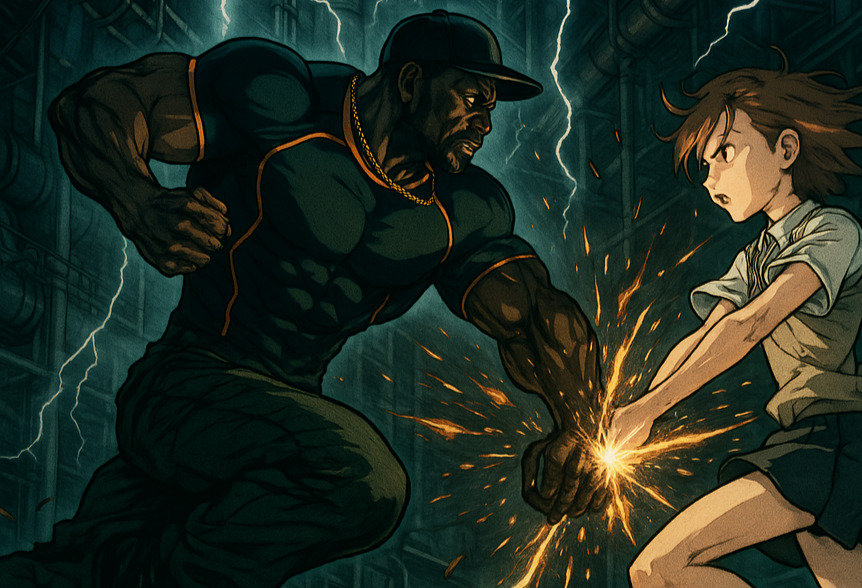
A CERTAIN SCIENTIFIC RAILGUN: WHEN EXCELLENCE MEETS SYSTEMATIC PROGRESSION
Before you read another word, answer these questions honestly:
What natural talents are you coasting on instead of systematically developing?
When you face someone stronger, do you try harder—or do you adapt your strategy?
How do you handle setbacks—do you retreat, or do you analyze, adjust, and attack again?
Are you building genuine relationships based on mutual growth, or just surrounding yourself with people who validate your current level?
What would systematic progression look like in your primary area of development over the next 90 days?
What up world, Xavier Savage here from xperformancelab.com.
While everyone’s debating whether Railgun is better than the main Index series, I’m over here analyzing the most systematically developed protagonist in the entire Toaru franchise.
Misaka Mikoto represents everything Touma should have been—a character who faces genuine challenges, develops strategic thinking, and systematically evolves through adversity. She doesn’t win because plot armor says so. She wins because she adapts, learns, and applies systematic thinking to her natural abilities.
This isn’t just the best entry in the franchise. It’s a blueprint for how character development should work when you combine natural talent with disciplined progression.
Your body is your first kingdom. Your abilities are your first weapons. Misaka understood that raw power is just the starting point. Most of you still don’t.
THE XPL ENERGY TIER FRAMEWORK
| Level | Focus | Icon | Client State |
|---|---|---|---|
| Level I: Awareness | Exposure | 🪞 | “I didn’t know what I didn’t know” |
| Level II: Activation | Questioning | ⚡ | “Maybe what I’ve been doing isn’t working” |
| Level III: Execution | Deployment | 🛠️ | “I execute regardless of how I feel” |
| Level IV: Elite Mode | Mastery | 🔥 | “How can I extract 10% more from this system?” |
| Level V: Peak Mastery | Integration | 🧠 | “Discipline is my default setting” |
This post is for Level III and Level IV readers. If you’re still relying on raw talent without systematic development, keep scrolling. This isn’t for you.
XPL PERSPECTIVE FRAMEWORK
| Intensity | Icon | Purpose | When To Use |
|---|---|---|---|
| 🔍 | Surface Scan | Quick observations | Intro/transitions |
| ⚡ | Deep Cut | Tactical analysis | Main sections |
| 🔥 | Full Assault | Controversial takes | Hot takes/criticism |
| 💀 | Nuclear Option | Destroying sacred cows | Obliterating popular opinions |
A CERTAIN SCIENTIFIC RAILGUN RATING BREAKDOWN
Story/Plot Development: Level IV: Elite Mode (🔥🔥🔥🔥/5)
Each arc builds systematically on previous developments while exploring deeper themes. The Sisters arc alone represents some of the most emotionally devastating and strategically complex storytelling in anime.
The narrative doesn’t rely on convenience—it establishes rules, follows them, and shows consequences. When Misaka discovers the Level 6 Shift project, her response isn’t immediate victory through hidden power. It’s systematic analysis, strategic planning, and recognition that she can’t solve this problem alone.
XPL Performance Physics: Law 3—Systems Beat Intensity Over Time. The Sisters arc demonstrates that raw power (Misaka’s electromaster abilities) isn’t enough against a system designed to neutralize individual capability. Victory requires strategy, alliance, and systematic thinking.
Savage Command: “Your system works or your excuses work. Pick one.”
Character Development: Level V: Peak Mastery (🧠🧠🧠🧠🧠/5)
Misaka’s evolution from arrogant prodigy to strategic leader who understands the value of teamwork and systematic thinking represents character development done absolutely right.
Her progression arc:
Phase 1—Natural Talent: Academy City’s third-ranked Level 5. She believes her power is enough because it’s always been enough.
Phase 2—Confrontation with Limits: Meeting Accelerator shatters her belief that raw power solves everything. She faces someone who not only matches her but operates on an entirely different level.
Phase 3—Systematic Adaptation: Instead of just training harder, she analyzes her techniques, develops new applications, and learns when raw power isn’t the answer.
Phase 4—Strategic Leadership: She discovers she can’t protect everyone alone. The Sisters arc forces her to accept help, trust others, and coordinate collective action.
Phase 5—Integration: She becomes someone who wields power with wisdom, not just capability. Her identity shifts from “strongest” to “most effective.”
XPL Performance Physics: Law 2—Identity Precedes Outcome. Misaka’s power doesn’t increase dramatically through the series. Her effectiveness does—because who she is changes. She stops being the prodigy who happens to win and becomes the strategist who engineers victory.
Identity Mirror: What natural talents are you coasting on? When was the last time your identity evolved to match your challenges?
Animation/Fight Quality: Level IV: Elite Mode (🔥🔥🔥🔥/5)
J.C. Staff delivers their best work with Railgun. The electromagnetic abilities are showcased with creative tactical applications, and every fight feels consequential and strategic.
What makes the fights work:
-
Rules matter. Misaka’s abilities have limits, and those limits create tension.
-
Strategy beats power. She wins by outthinking opponents, not out-muscling them.
-
Consequences exist. Every battle leaves marks—physical, emotional, strategic.
-
Adaptation is visible. You see her learn and adjust mid-combat.
Training translation: How many of your workouts have this level of strategic intention? Are you just moving weight, or are you analyzing, adapting, and systematically progressing?
The Chain doesn’t negotiate. Neither should your training.
Overall Impact/Rewatchability: Level V: Peak Mastery (🧠🧠🧠🧠🧠/5)
This series fundamentally changed how I think about combining natural talent with systematic development. Every rewatch reveals new layers of strategic thinking and character growth.
The Sisters arc alone justifies the entire franchise. It’s a masterclass in:
-
Ethical complexity under institutional pressure
-
The cost of power without wisdom
-
The necessity of strategic alliances
-
Recovery from psychological devastation
-
Systematic approach to preventing future harm
Savage Command: “Study what rewards rewatch. Substance compounds; spectacle fades.”
🔥 FULL ASSAULT: SYSTEMATIC EXCELLENCE VS. POPULAR TRASH
💀 Nuclear Option:
Railgun succeeds where 90% of anime fails because it understands that being naturally gifted is just the starting point, not the finish line.
Misaka begins as Academy City’s third-ranked Level 5. She’s already elite. Most stories would end there—protagonist has achieved peak, now watch them coast.
Railgun asks: What happens when elite meets elite?
Misaka’s real development comes from learning strategic thinking, teamwork, and systematic problem-solving. She faces opponents who force her to adapt techniques, develop new applications of her powers, and learn when raw power isn’t enough.
Compare this to generic overpowered protagonists:
-
The “I win because I’m the protagonist” model: Power without progression, victory without growth
-
The “scream louder” model: Intensity substitutes for strategy
-
The “hidden power” model: Convenience replaces development
-
The “friendship beats everything” model: Emotional appeals substitute for tactical thinking
Misaka earns her victories. She loses. She learns. She adapts. She wins through application, not author fiat.
The Mirror: Are you relying on natural talent to carry you, or are you systematically developing your abilities to handle increasingly complex challenges?
The Chain: Your natural gifts are entry tickets, not lifetime passes. Systematic development determines how far you go.
⚡ DEEP CUT: CULTURAL/REPRESENTATION ANALYSIS
Female Characters Done Right
The series presents strong female characters who aren’t defined by their relationships with male protagonists.
Misaka Mikoto: Defined by her power, her principles, and her growth. Her occasional interest in Touma is a character quirk, not an identity.
Kuroko Shirai: Loyal, capable, and complex. Her devotion to Misaka could have been reduced to comic relief, but the series shows genuine partnership and mutual respect beneath the surface.
Uiharu Kazari: Technical genius whose value isn’t measured in combat power. The series demonstrates that different capabilities create different forms of strength.
Saten Ruiko: The Level 0 who refuses to be defined by the system’s hierarchy. Her arc explores how people maintain dignity when institutions declare them worthless.
These characters develop genuine friendships based on mutual respect and shared experiences rather than romantic competition. They argue, support, challenge, and grow together.
XPL Application: This is what genuine partnership looks like—people who amplify each other’s capabilities without losing individual identity.
The Throne: Are you building relationships based on mutual growth, or just surrounding yourself with people who validate your current level?
Academy City: Meritocracy or Systematic Inequality?
Academy City’s hierarchical structure creates interesting commentary on meritocracy versus systemic inequality.
The Level system creates:
-
Clear progression metrics: Everyone knows where they stand and what they need to advance
-
Resource allocation based on potential: Higher levels get better education, training, opportunities
-
Systematic discrimination: Level 0s face limited options regardless of other capabilities
-
Self-fulfilling prophecies: Those labeled “weak” often remain weak because resources flow to the “strong”
The uncomfortable truth the series exposes:
Meritocracy sounds fair until you realize that initial advantages compound. Level 5s like Misaka have access to advanced education and resources that Level 0s never see. The system doesn’t just measure merit—it creates it.
XPL Application: This mirrors real-world dynamics. Those born with advantages often mistake their success for pure merit, ignoring the systems that elevated them. Those born without advantages face barriers that have nothing to do with capability.
The Chain: How do you use your advantages to elevate others rather than just advancing your own position?
Savage Command: “Build what outlasts you—including opportunities for those who come after.”
🔍 SURFACE SCAN: CHARACTER DEVELOPMENT PSYCHOLOGY
Misaka’s Psychological Evolution
Misaka’s psychological profile reveals how confidence can become arrogance without proper challenges, and how facing limitations forces genuine growth.
Stage 1: The Prodigy’s Arrogance
She’s always been powerful. Always been respected. Always been enough. This creates a blind spot—she assumes her methods work everywhere because they’ve always worked here.
Stage 2: The Shattering
Her encounter with Accelerator destroys this assumption. She faces someone who not only matches her power but operates on an entirely different level. More importantly, she faces the limits of her approach—raw power isn’t enough against someone who understands power systematically.
Stage 3: The Adaptation
Instead of retreating or denying, she analyzes. What worked? What didn’t? What can she learn from the person who defeated her? This is the moment she transitions from talented to strategic.
Stage 4: The Confrontation with Consequence
The Sisters arc devastates her psychologically. She discovers that her genetic material has been used to create 20,000 clones, and those clones are being systematically murdered for Accelerator’s level progression.
This isn’t a challenge to her power—it’s a challenge to her identity. She has to confront:
-
Her powerlessness to stop it alone
-
Her complicity (however unwitting) in the project
-
The limits of individual action against institutional systems
-
The psychological weight of 20,000 deaths she couldn’t prevent
Stage 5: Recovery Through Strategy
Her recovery and systematic approach to preventing further tragedies demonstrates real character development. She doesn’t just feel bad and then feel better. She:
-
Analyzes the problem systematically
-
Identifies leverage points
-
Builds strategic alliances
-
Accepts help she would have previously refused
-
Develops a plan that addresses root causes, not just symptoms
XPL Application: This is the difference between emotional processing and strategic processing. Misaka doesn’t just heal—she evolves. The trauma becomes data that informs future action.
Identity Mirror: How do you handle setbacks—do you retreat like early Misaka, or adapt your strategy and try new approaches?
⚡ DEEP CUT: WORLD-BUILDING & SYSTEMS THINKING
Academy City as Performance Laboratory
Academy City operates as a functioning research institution with clear hierarchies, systematic power development, and measurable progression metrics. Students advance through testing, training, and demonstrated competence—similar to how systematic strength training should work.
The Level system creates:
Transparent progression paths: Students can see exactly what they need to develop to advance. No ambiguity, no politics—just clear metrics and known requirements.
Measurable outcomes: Progress isn’t subjective. You either advance or you don’t. The system eliminates self-deception.
Resource allocation efficiency: Those who demonstrate capability receive resources to develop further. The system invests where returns are highest.
Competitive pressure: Everyone knows their rank and what’s required to move up. This creates continuous motivation for development.
But the series also shows the dark side:
Systemic discrimination: Level 0s face limited options regardless of other capabilities. The system that claims to measure merit actually creates hierarchies that become self-perpetuating.
Institutional exploitation: The Sisters arc reveals that the system that develops power also exploits it. Academy City isn’t just educating students—it’s creating weapons.
Moral hazard: Those at the top benefit so much from the system that they stop questioning its ethics. Misaka’s initial ignorance of the Level 6 Shift project isn’t accidental—the system is designed to keep beneficiaries comfortable and unaware.
XPL Application: Every system has both visible functions and hidden costs. The question isn’t whether a system works—it’s who it works for and who it works on.
Savage Command: “Study how systems actually function, not how they’re advertised.”
Electromaster Abilities as Tactical Framework
Misaka’s electromagnetic abilities showcase creative applications of scientific principles, demonstrating how systematic understanding leads to tactical innovation.
Her ability applications include:
-
Railgun: Direct application of electromagnetic force—raw power with precision
-
Electromagnetic sensing: Environmental awareness through magnetic fields
-
Iron sand manipulation: Versatile offensive and defensive applications
-
Electromagnetic interference: Disabling electronics, creating tactical advantages
-
Magnetic field manipulation: Controlling metal objects, altering environment
What makes this brilliant:
Each application flows from the same core ability but serves different tactical purposes. Misaka doesn’t just have one power—she has a system that generates infinite applications.
Training translation: This is the difference between someone who can bench press and someone who understands biomechanics, programming, and recovery. The first has one ability. The second has a system that generates infinite applications.
XPL Performance Physics: Law 3—Systems Beat Intensity Over Time. Raw power plateaus. Systematic understanding compounds.
🔍 SURFACE SCAN: TRAINING/STRATEGY PHILOSOPHY
Misaka’s approach to developing her abilities mirrors effective training methodology:
Progressive Overload
She systematically increases the complexity and power of her electromagnetic techniques. She doesn’t just use the same moves harder—she develops new applications, refines existing ones, and tests limits in controlled environments.
Application: Your training should follow the same pattern. Don’t just add weight to the same lifts—develop new movement patterns, refine technique, and systematically increase complexity.
Specificity
Her training targets practical applications rather than just raw power increases. She develops techniques that solve specific problems she’s encountered or anticipates.
Application: Train for your actual objectives. If your goal is functional strength, train movements, not just muscles. If your goal is aesthetic development, train for the specific look you want. Generic training produces generic results.
Recovery
She learns to manage the physical and mental costs of high-level ability usage. The series shows her exhausted, depleted, and pushing too hard—and shows the consequences.
XPL Performance Physics: Law 4—Recovery Drives Adaptation. Misaka’s growth doesn’t happen during battles. It happens in the space between them, when her system rebuilds stronger.
Application: Are you recovering as strategically as you train? Sleep architecture, parasympathetic activation, nutritional timing—these aren’t optional. They’re where champions are built.
Savage Command: “Rest is strategy, not weakness.”
Adaptation
She modifies techniques based on opponent analysis and environmental factors. She doesn’t have a fixed moveset—she has a flexible system that adapts to conditions.
Application: This is the difference between someone who has a routine and someone who has a methodology. Routines break when conditions change. Methodologies adapt.
🔥 FULL ASSAULT: LEGACY & IMPACT
💀 Nuclear Option:
Railgun proved that spinoff series can surpass their source material when they focus on systematic character development over convenient plot progression.
What Railgun did differently:
Character-first storytelling: Every plot development serves character growth. The Sisters arc exists because it forces Misaka to evolve, not because the plot needed drama.
Systematic power exploration: The series explores what Misaka’s abilities can actually do, rather than inventing new powers when convenient.
Consequences matter: Decisions have costs. Victories leave marks. The series respects the weight of its own events.
Female characters as people: Misaka, Kuroko, Uiharu, and Saten exist for themselves, not as support for male protagonists.
The influence:
The series influenced how female protagonists are written in anime, showing that strength doesn’t require abandoning feminine characteristics or emotional intelligence. Characters can be powerful and complex and feminine and strategic—all simultaneously.
The tactical applications of Misaka’s electromagnetic abilities inspired creative power usage in subsequent anime. Writers learned that systematic exploration of ability mechanics creates more engaging battles than raw power escalation.
Savage Command: “Develop systematic applications of your natural abilities rather than just trying to use them harder.”
The Throne: What natural talents are you failing to develop systematically because you assume raw ability is enough?
THE MASTERY SYMBOLS
🔗 The Chain: Your natural gifts connect to your potential, but systematic development determines how far that chain reaches. Misaka was gifted. She became elite through application, not inheritance.
🪞 The Mirror: What natural talents are you coasting on? When you face someone stronger, do you try harder—or do you adapt your strategy?
👑 The Throne: How will you apply systematic progression to your primary area of development over the next 90 days?
FINAL STRATEGIC ASSESSMENT
Railgun succeeds where most anime fails because it understands a fundamental truth:
Raw talent is just the starting point.
Misaka begins as Academy City’s third-ranked Level 5. She’s already at the top. Most stories would end there.
Instead, Railgun asks: What happens when elite meets elite? What happens when power meets power? What happens when the strongest faces someone stronger, faster, more strategic?
The answer isn’t “try harder.” It’s “think better.”
Misaka develops:
-
Strategic thinking over reactive response
-
Systematic application over raw power
-
Team coordination over individual heroics
-
Adaptation over repetition
-
Wisdom over capability
The Mirror: Are you doing the same?
The Chain: Your natural abilities got you here. Systematic development determines where you go next.
The Throne: The choice is yours—coast on talent or develop through system.
IDENTITY MIRROR QUESTIONS
What natural talents are you underutilizing because you haven’t systematically developed their applications?
When was the last time you faced someone who made your usual approach useless—and how did you respond?
What would systematic progression look like in your primary area of development over the next 90 days?
How do you handle setbacks—do you retreat like early Misaka, or adapt your strategy and try new approaches?
What relationships in your life are based on mutual growth versus mutual validation?
How do you use your advantages to elevate others while continuing your own advancement?
What systems in your environment benefit you while exploiting others—and what responsibility do you have to notice?
ACTION TRIGGER QUESTIONS
What’s one natural talent you’ll stop coasting on and start developing systematically this week?
Who will you talk to about strategic adaptation—someone who’s faced stronger opponents and learned to win differently?
What’s the minimum viable systematic application you can add to your training today?
How will you measure progression over the next 90 days—what metrics actually matter?
Who can you elevate using your advantages this month?
What system will you examine for hidden costs—not just benefits?
RESOURCE DROP
Follow my daily insights on Instagram @xperformancelab and YouTube @xperformancelab.
For those in Houston demanding the highest level of training, in-person sessions are available at VFit Gym, 5535 Richmond Ave, Houston, TX.
Elite online training systems at xperformancelab.com.
Take the Archetype Quiz to discover your specific body type protocol: xperformancelab.com/quiz
Inertia Over Inspiration. Always.
Execute.
Scroll to unlock levels
Level V Achieved
Now live it.
Unlocked
Leave a Reply