
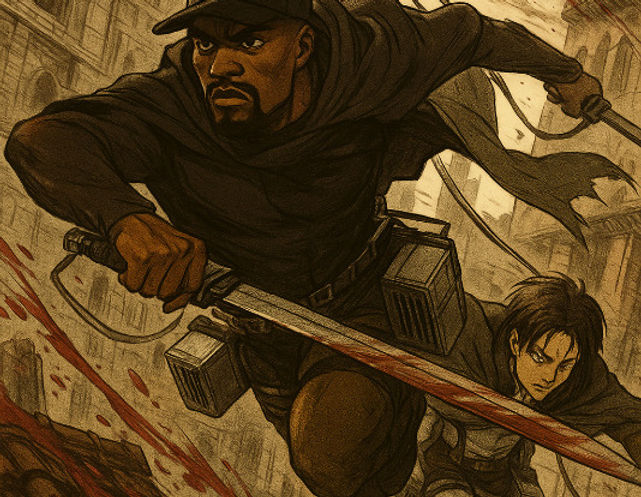
BLACK LAGOON: WHEN LAWLESS ENVIRONMENTS DEMAND STRATEGIC ADAPTATION
Before you read another word, answer these questions honestly:
What environments are you navigating that have no rules—and are you adapting or breaking?
When legal structures fail, what backup systems have you built?
How do you maintain identity when survival requires becoming someone else?
What capabilities have you developed specifically for lawless conditions?
Five years from now, when you look back at this moment, will you be grateful you adapted—or regretful you tried to impose order on chaos?
What up world, Xavier Savage here from xperformancelab.com.
Black Lagoon isn’t another pirate adventure. It’s a systematic study of how normal people adapt when legal structures completely fail.
Salaryman turned mercenary. Office worker turned gunrunner. Accountant turned smuggler. The series asks: When civilization disappears, who do you become?
Your body is your first kingdom. Your adaptability is your first survival mechanism. Rock’s journey from corporate drone to Lagoon Company member shows what happens when environment demands evolution—and what it costs.
THE XPL ENERGY TIER FRAMEWORK
| Level | Focus | Icon | Client State |
|---|---|---|---|
| Level I: Awareness | Exposure | 🪞 | “I didn’t know what I didn’t know” |
| Level II: Activation | Questioning | ⚡ | “Maybe what I’ve been doing isn’t working” |
| Level III: Execution | Deployment | 🛠️ | “I execute regardless of how I feel” |
| Level IV: Elite Mode | Mastery | 🔥 | “How can I extract 10% more from this system?” |
| Level V: Peak Mastery | Integration | 🧠 | “Discipline is my default setting” |
This post is for Level III and Level IV readers. If you’re still expecting orderly environments to protect you, Black Lagoon will shatter that illusion.
XPL PERSPECTIVE FRAMEWORK
| Intensity | Icon | Purpose | When To Use |
|---|---|---|---|
| 🔍 | Surface Scan | Quick observations | Intro/transitions |
| ⚡ | Deep Cut | Tactical analysis | Main sections |
| 🔥 | Full Assault | Controversial takes | Hot takes/criticism |
| 💀 | Nuclear Option | Destroying sacred cows | Obliterating popular opinions |
BLACK LAGOON RATING BREAKDOWN
Story/Plot Development: Level IV: Elite Mode (🔥🔥🔥🔥/5)
Black Lagoon constructs its narrative like systematic exploration of adaptation to lawless environments. Roanapur isn’t just a setting—it’s a pressure cooker that reveals what people really are when rules disappear.
What the series understands:
-
Crime isn’t rebellion—it’s economics
-
Morality is luxury only the powerful can afford
-
Everyone adapts or dies; there’s no third option
-
The environment doesn’t care about your feelings
Each arc examines different survival strategies—the nun who runs guns, the maid who kills, the twins who became weapons, the accountant who chose freedom over safety.
XPL Performance Physics: Law 3—Systems Beat Intensity Over Time. The characters who survive aren’t the strongest or most emotional. They’re the ones who adapt their systems to match the environment.
Savage Command: “Your environment will change you whether you choose it or not. Choose the direction.”
Character Development: Level IV: Elite Mode (🔥🔥🔥🔥/5)
Rock’s evolution from salaryman to something else entirely demonstrates how environment transforms identity when adaptation is survival.
His arc:
Phase 1—Corporate Shell: Rules, hierarchy, predictability. He’s successful by company standards—and completely unremarkable.
Phase 2—Forced Adaptation: Kidnapped, threatened, forced to operate outside all familiar systems. His corporate skills become useless overnight.
Phase 3—Recalibration: He discovers his value isn’t in following rules—it’s in understanding people, negotiating, seeing angles that fighters miss.
Phase 4—Integration: He stops being the hostage and starts being crew. Not because he learned to fight, but because he learned to contribute something fighters can’t.
Phase 5—Transformation: By the end, he’s no longer the salaryman who arrived. He’s become someone who can navigate lawlessness while maintaining enough of himself to matter.
XPL Performance Physics: Law 2—Identity Precedes Outcome. Rock’s identity had to shift before his capability could expand. He didn’t become capable and then change—he changed, and capability followed.
Identity Mirror: What identity are you holding that prevents adaptation to your actual environment?
Animation/Fight Quality: Level III: Execution (🛠️🛠️🛠️/5)
Madhouse delivers action that serves realism over spectacle. Guns have recoil. Wounds matter. Death is permanent.
What the fights communicate:
-
Violence isn’t choreography—it’s chaos
-
The person who hesitates dies
-
Superior firepower doesn’t guarantee survival
-
Every bullet has consequences
Training translation: Real conflict isn’t a tournament arc. It’s unpredictable, unfair, and uninterested in your preparation level. Train for chaos, not ceremony.
The Chain doesn’t negotiate. Neither should your combat readiness.
Overall Impact/Rewatchability: Level IV: Elite Mode (🔥🔥🔥🔥/5)
Black Lagoon rewards analysis like studying survival psychology rewards adaptation understanding. Multiple viewings reveal strategic layers surface watchers miss.
What rewatching reveals:
-
Rock’s transformation cues you missed
-
Environmental pressures that shaped each character
-
Moral choices that seemed simple but weren’t
-
The cost of every adaptation
Savage Command: “Study what rewards rewatch. Survival principles compound; action spectacle fades.”
🔥 FULL ASSAULT: SYSTEMATIC EXCELLENCE VS. POPULAR TRASH
💀 Nuclear Option:
Most anime present violence as spectacle—choreographed, consequence-free, entertaining. Black Lagoon presents violence as what it actually is: environmental pressure that reveals character.
What the series understands about lawless environments:
Rule 1—The environment doesn’t care. Roanapur isn’t evil—it’s indifferent. It doesn’t want to hurt you; it just doesn’t care if you survive. This distinction matters. Evil can be fought. Indifference must be navigated.
Rule 2—Morality is expensive. The characters who maintain “principles” die quickly or become irrelevant. Survival requires choices that comfortable people judge—from comfort.
Rule 3—Adaptation is identity destruction. You don’t become someone who survives lawlessness without losing the person who arrived. Rock can never go back to being a salaryman. That person is dead.
Rule 4—Capability is contextual. Revy’s skills make her deadly in Roanapur and useless in Tokyo. Rock’s corporate skills made him valuable in Japan and useless in Thailand. Value depends on environment.
Rule 5—Alliances are temporary. Every relationship in Roanapur is transactional. The moment the transaction stops benefiting both parties, the alliance ends—often violently.
Compare this to typical “outlaw” narratives:
-
Romanticized criminality: Crime as rebellion, not economics
-
Convenient morality: Outlaws with hearts of gold
-
Friendship solves everything: Bonds transcend environmental pressure
-
Plot armor: The main character survives because the story needs them to
Black Lagoon refuses every convenience. Rock survives because he adapts—not because the plot protects him.
The Mirror: What environments are you navigating that have no rules—and are you adapting or breaking?
The Chain: Your adaptation strategy determines your survival. What’s your strategy?
⚡ DEEP CUT: CHARACTER DEVELOPMENT PSYCHOLOGY
Rock: The Salaryman Who Chose Chaos
Rock represents what happens when a normal person faces lawlessness and must decide who to become.
His psychology entering Roanapur:
-
Conditioned to follow rules
-
Believes in order, hierarchy, predictable outcomes
-
Assumes good faith from others
-
Thinks negotiation means compromise, not survival
The shattering:
His kidnapping destroys every assumption. The company won’t save him. Japanese law doesn’t apply. His skills mean nothing. He’s completely, utterly helpless.
The adaptation:
Instead of breaking, he observes. He watches how the Lagoon crew operates—not their techniques, but their thinking. He realizes:
-
Revy survives through overwhelming violence
-
Dutch survives through strategic positioning
-
Benny survives through technical irreplaceability
-
He needs a different survival strategy
His niche emerges:
He can talk to people the crew can’t. He understands corporate thinking, political nuance, the logic of the world they left. He becomes the translator—not of language, but of meaning.
The cost:
Every successful negotiation, every saved crew member, every mission completed—each one kills the salaryman a little more. By the time he’s fully adapted, the person who arrived no longer exists.
XPL Performance Physics: Law 1—Energy Debt Compounds Faster Than Discipline. Rock’s adaptation isn’t free. Every survival choice accumulates debt. The question isn’t whether he’ll pay—it’s when.
Identity Mirror: What identities are you killing to survive your environment?
Revy: The Weapon Who Never Became a Person
Revy represents the opposite trajectory—someone who adapted so completely she lost the person she could have been.
Her psychology:
-
Trauma weaponized into capability
-
Trust replaced with suspicion
-
Connection seen as vulnerability
-
Violence as first, last, and only response
The tragedy:
Revy didn’t choose this. Roanapur made her. The environment demanded adaptation, and she adapted completely. Now she can’t go back. The person she could have been is dead—killed by survival.
Her relationship with Rock:
Rock represents something Revy lost—the ability to navigate without violence, to connect without suspicion, to be human. She’s drawn to him not romantically, but nostalgically. He’s what she could have been.
The impossibility:
She can’t become him. The environment that made her won’t allow it. But she can protect him, keep him alive, ensure that version of humanity survives somewhere.
XPL Performance Physics: Law 4—Recovery Drives Adaptation. Revy never recovered between adaptations. Each survival experience built on the last without processing, without rest, without integration. She became highly adapted and completely unrecoverable.
Identity Mirror: What parts of yourself have you sacrificed for survival that you can never recover?
Balalaika: The Predator Who Understands Systems
Balalaika represents the most sophisticated adaptation—someone who brought systematic thinking to lawlessness and became untouchable.
Her background:
Former Soviet military officer. She understands:
-
Hierarchies (how to build them)
-
Logistics (how to sustain them)
-
Psychology (how to exploit it)
-
Strategy (how to win before fighting)
Her advantage:
She never adapted to Roanapur—she adapted Roanapur to her. She imposed military thinking on criminal chaos and created order within disorder.
The lesson:
The most dangerous person in any environment isn’t the strongest or fastest. It’s the one who understands how the environment works and builds systems that exploit that understanding.
XPL Performance Physics: Law 3—Systems Beat Intensity Over Time. Balalaika doesn’t outfight opponents—she outsystems them. Her hotel room isn’t just cover—it’s strategic positioning. Her connections aren’t just relationships—they’re force multipliers.
Savage Command: “Don’t just survive your environment. Learn it well enough to reshape it.”
⚡ DEEP CUT: WORLD-BUILDING & SYSTEMS THINKING
Roanapur as Environmental Pressure Chamber
Roanapur isn’t just a setting—it’s a selective pressure that shapes everyone who enters.
The city’s operating principles:
No law, only power. Legal structures don’t exist. Protection comes from capability, alliance, or reputation—never from rights.
No future, only present. Long-term planning is luxury. Survival requires immediate adaptation to immediate threats.
No sentiment, only transaction. Relationships exist as long as they benefit both parties. The moment calculation changes, connection ends.
No escape, only adaptation. Everyone in Roanapur arrived by choice or circumstance. Almost no one leaves. The city is final destination.
The selection pressure in action:
-
Weak die quickly
-
Sentimental die eventually
-
Rigid die when environment shifts
-
Only the adaptable survive long-term
XPL Application: This is what high-pressure environments do. They reveal what you really are—not what you claim, not what you intend, but what you actually are when rules disappear.
Savage Command: “Your environment reveals you. Design it carefully.”
The Economic Logic of Lawlessness
Black Lagoon understands something most crime stories miss: illegal economies follow economic logic.
Supply and demand still apply. Guns are worth more in conflict zones. Drugs are worth more where prohibition creates scarcity. People are worth more where desperation creates supply.
Competition still exists. Multiple criminal organizations compete for territory, resources, and market share. The competition is just more lethal.
Branding still matters. Reputation functions as brand equity. Reliable smugglers get repeat business. Unpredictable operators get avoided.
Customer service still counts. The Triads, the Church, the Colombians—they all need clients to return. Good service means survival; bad service means finding new customers or dying.
The lesson: Lawlessness doesn’t mean absence of rules—it means replacement of legal rules with survival rules. The game still has structure; the structure is just more brutal.
XPL Application: Your environment has rules whether you acknowledge them or not. Learn them or be eliminated by them.
🔍 SURFACE SCAN: TRAINING/STRATEGY PHILOSOPHY
Black Lagoon demonstrates how survival in extreme environments requires specific capabilities that comfort-zone training never develops.
What the series teaches about adaptation:
1. Context determines capability value.
Rock’s corporate skills were worthless in Roanapur until he found their new application—negotiation, psychology, understanding how “legitimate” minds work. The skills didn’t change; their context did.
Application: What skills do you have that might be valuable in different contexts? Don’t assume value is fixed.
2. Survival requires multiple capabilities.
Revy’s violence alone isn’t enough. Dutch’s strategy alone isn’t enough. Benny’s tech alone isn’t enough. Rock’s negotiation alone isn’t enough. Together, they create capability no individual possesses.
Application: What capabilities are you missing that could come from partnership rather than development?
3. Adaptation speed determines survival.
The characters who survive environmental shifts are the ones who recognize change quickly and adapt immediately. Those who wait to confirm die waiting.
Application: How quickly do you recognize when your environment has changed? How fast do you adapt?
4. Identity flexibility is survival advantage.
Rock survives because he can become someone else. Revy survives because she became someone else permanently. Balalaika survives because she brings her identity with her and imposes it on environment.
Application: Is your identity flexible enough to survive environmental change? Or are you rigid until you break?
5. Cost calculation must be honest.
Every adaptation costs something. Rock loses his old self. Revy lost her humanity. Dutch lost his country. Benny lost his future. Survival isn’t free.
Application: What are you willing to pay for survival? What aren’t you willing to pay—and what does that choice cost?
XPL Performance Physics: Law 7—Accountability Structures Determine Execution Rates. In Roanapur, accountability isn’t optional. Fail your crew, die. Betray your partner, die. Make a mistake, die. The stakes create focus.
Savage Command: “Train for your actual environment, not the one you wish existed.”
🔥 FULL ASSAULT: LEGACY & IMPACT
💀 Nuclear Option:
Black Lagoon influenced how anime portrays crime, violence, and adaptation by refusing to romanticize any of them.
What it accomplished:
De-romanticized criminality: Showed crime as work—dangerous, stressful, unglamorous work that kills people and leaves survivors damaged.
Normalized female violence without fetishizing it: Revy is deadly because her environment made her deadly, not because the camera wants to objectify her.
Explored moral complexity without moralizing: The series doesn’t tell you what to think about Rock’s choices. It shows consequences and lets you decide.
Demonstrated environmental determinism: Who you become depends heavily on where you are. Roanapur makes monsters; Tokyo makes salarymen. The difference isn’t character—it’s context.
The influence:
Later series incorporated these insights—showing crime as economics, violence as consequence, adaptation as necessity. Jormungand, Gangsta., even elements of Cowboy Bebop‘s darker moments all build on Black Lagoon‘s foundation.
Savage Command: “Adapt to your environment or be eliminated by it. There’s no third option.”
The Throne: Most people who find Black Lagoon “too dark” are revealing their inability to face what they’d become under pressure. They prefer the fantasy that they’d stay good. The series knows better.
THE MASTERY SYMBOLS
🔗 The Chain: Your environment connects to your identity. Change one, change the other. Choose both carefully.
🪞 The Mirror: When you watch Rock transform, do you see any reflection of your own adaptation? What are you becoming to survive your environment?
👑 The Throne: How will you navigate lawless conditions without losing yourself completely? What line won’t you cross—and are you sure you’ll hold it under pressure?
FINAL STRATEGIC ASSESSMENT
Black Lagoon asks questions most narratives avoid:
What would you become if rules disappeared? Not what you hope you’d become—what would actually happen when survival required choices you’ve never faced?
Can you maintain identity under pressure? Or would you adapt so completely that the person who arrived no longer exists?
What’s worth dying for? And what’s worth killing for? The answers aren’t theoretical in Roanapur.
Is adaptation always victory? Rock survives and adapts. But the person who arrived in Roanapur died there. Was that victory or just different defeat?
Savage Command: “Adapt to hostile environments without losing yourself completely. The balance is survival.”
Savage Command: “Your environment will change you whether you choose it or not. Choose the direction.”
Savage Command: “Train for the environment you’re in, not the one you wish existed.”
IDENTITY MIRROR QUESTIONS
What environments are you navigating that have no rules—and are you adapting or breaking?
When legal structures fail, what backup systems have you built?
How do you maintain identity when survival requires becoming someone else?
What capabilities have you developed specifically for lawless conditions?
What identities are you killing to survive your environment?
What parts of yourself have you sacrificed for survival that you can never recover?
What would you become if rules disappeared—really, not ideally?
ACTION TRIGGER QUESTIONS
What’s one environment you’re in that requires different capabilities than you currently have?
What skill could you develop that would be valuable in multiple contexts?
Who do you know who’s successfully adapted to challenging conditions—what can you learn from them?
How will you test your adaptation speed this week?
What line won’t you cross—and how will you ensure you hold it under pressure?
What cost are you paying for survival that you haven’t acknowledged?
RESOURCE DROP
Follow my daily insights on Instagram @xperformancelab and YouTube @xperformancelab.
For those in Houston demanding the highest level of training, in-person sessions are available at VFit Gym, 5535 Richmond Ave, Houston, TX.
Elite online training systems at xperformancelab.com.
Take the Archetype Quiz to discover your specific body type protocol: xperformancelab.com/quiz
Inertia Over Inspiration. Always.
Execute.
Scroll to unlock levels
Level V Achieved
Now live it.
Unlocked
Leave a Reply