
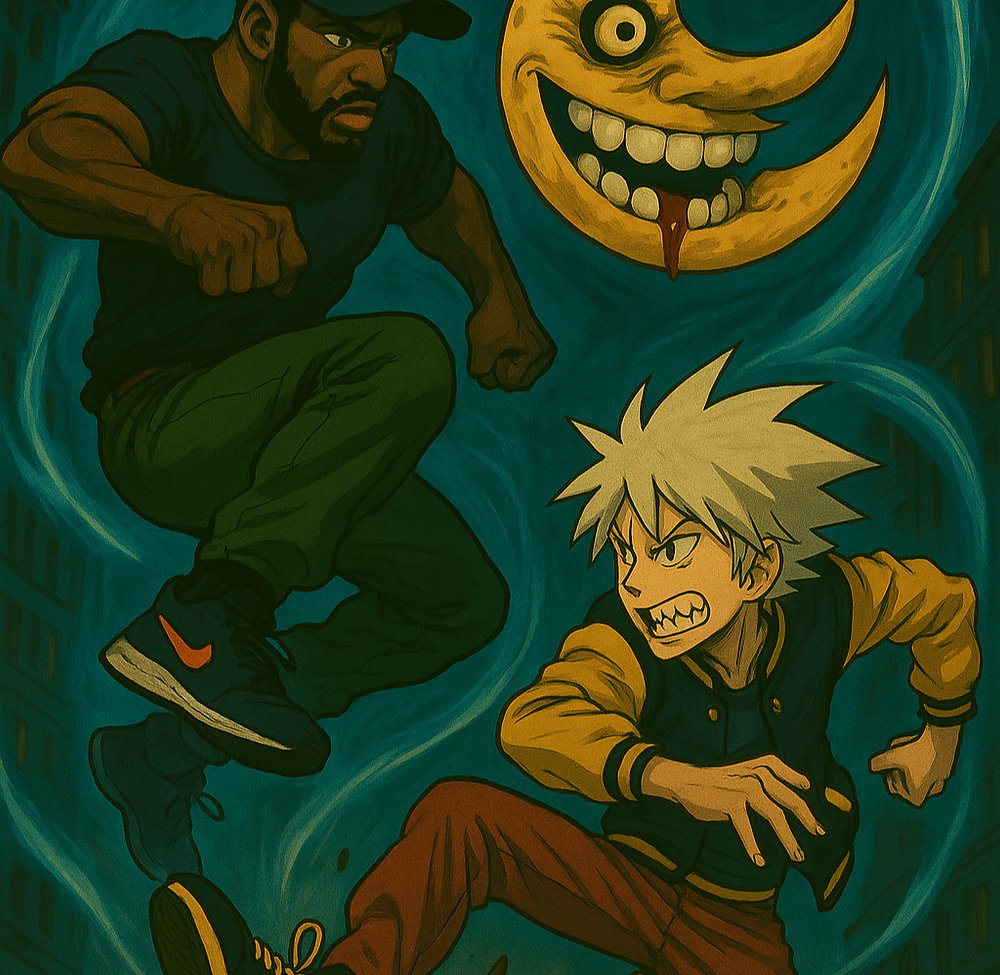
SOUL EATER: WHEN PARTNERSHIP PSYCHOLOGY MEETS RESONANCE TRAINING — Level IV: Elite Mode
Before you read another word, answer these questions honestly:
What partnerships in your life lack disciplined psychological development and mutual adaptation?
How does your preference for comfortable cooperation prevent you from building real resonance with key people?
When you work with others, do you maintain your comfort zone—or adapt to create collective capability?
What would authentic teamwork look like if it required the same discipline as individual training?
Five years from now, when you look back at this moment, will you have built partnerships that resonate—or just relationships that coexist?
What up world, Xavier Savage here from xperformancelab.com.
Partnership without psychological resonance produces mediocre results. Partnership WITH disciplined synchronization creates Soul Eater—a series that demonstrates how authentic teamwork requires psychological alignment and mutual development rather than convenient cooperation.
I’m examining why this anime understands what most team-building content completely misses. Soul Eater doesn’t present teamwork as friendship with benefits. It explores partnership as psychological conditioning that requires surrendering individual comfort for collective capability. The weapon-meister dynamic serves as perfect metaphor for how real partnerships demand mutual adaptation, psychological trust, and disciplined resonance development.
Your body is your first kingdom. Your partnerships are your first force multipliers. Maka and Soul don’t win because they’re friends. They win because they’ve done the psychological work to become more together than either could alone.
THE XPL ENERGY TIER FRAMEWORK
| Level | Focus | Icon | Client State |
|---|---|---|---|
| Level I: Awareness | Exposure | 🪞 | “I didn’t know what I didn’t know” |
| Level II: Activation | Questioning | ⚡ | “Maybe what I’ve been doing isn’t working” |
| Level III: Execution | Deployment | 🛠️ | “I execute regardless of how I feel” |
| Level IV: Elite Mode | Mastery | 🔥 | “How can I extract 10% more from this system?” |
| Level V: Peak Mastery | Integration | 🧠 | “Discipline is my default setting” |
This post is for Level IV readers. If you’re still treating teamwork like personality compatibility instead of psychological development, this analysis will expose your gaps.
XPL PERSPECTIVE FRAMEWORK
| Intensity | Icon | Purpose | When To Use |
|---|---|---|---|
| 🔍 | Surface Scan | Quick observations | Intro/transitions |
| ⚡ | Deep Cut | Tactical analysis | Main sections |
| 🔥 | Full Assault | Controversial takes | Hot takes/criticism |
| 💀 | Nuclear Option | Destroying sacred cows | Obliterating popular opinions |
SOUL EATER RATING BREAKDOWN
Story/Plot Development: Level IV: Elite Mode (🔥🔥🔥🔥/5)
Soul Eater constructs its academy narrative like partnership development program—each arc focuses on different aspects of psychological resonance, trust building, and collective capability advancement rather than individual hero journeys.
What the series understands:
-
Real partnership requires psychological work, not just friendship
-
Resonance is a skill, not a feeling
-
Different personalities create different partnership dynamics
-
The weapon-meister bond must be earned, not assumed
Death Weapon Meister Academy isn’t just a setting—it’s a laboratory where different partnership models are tested, refined, and sometimes fail.
XPL Performance Physics: Law 7—Accountability Structures Determine Execution Rates. The weapon-meister bond creates ultimate accountability. Fail your partner, you both fail. Succeed together, you both grow.
Savage Command: “Your partnerships will only be as strong as the psychological work you put into them.”
Character Development: Level IV: Elite Mode (🔥🔥🔥🔥/5)
Maka and Soul’s partnership evolution demonstrates authentic psychological synchronization that requires mutual adaptation rather than convenient cooperation between compatible personalities.
Their arc:
Phase 1—Functional Partnership: They work together adequately. Skills complement, personalities don’t clash. Enough to pass, not enough to excel.
Phase 2—First Resonance Failure: They attempt Soul Resonance and fail. The technique reveals what their relationship lacks—true psychological alignment.
Phase 3—Confrontation: They must face what blocks resonance—fear, pride, unresolved tension, individual comfort zones.
Phase 4—Mutual Adaptation: Both change. Not to become each other, but to create space where both can be fully present while serving collective capability.
Phase 5—Resonance Achieved: When they finally synchronize, it’s not because they’re compatible—it’s because they’ve done the work.
Other partnerships explore different dynamics:
Black Star and Tsubaki: Overconfidence meets patience. His ego could destroy their partnership; her steadiness contains it.
Death the Kid and his weapons: Perfectionism meets adaptability. Liz and Patty accommodate his obsession while maintaining their own identities.
XPL Performance Physics: Law 2—Identity Precedes Outcome. Each partnership’s capability flows from who each person is—and who they become together.
Identity Mirror: What partnerships in your life lack disciplined psychological development and mutual adaptation?
Animation/Fight Quality: Level IV: Elite Mode (🔥🔥🔥🔥/5)
Bones delivers dynamic animation that visualizes psychological resonance through combat choreography and visual metaphor. Fight sequences demonstrate partnership synchronization rather than individual capability showcasing.
What the fights communicate:
-
Resonance isn’t just power—it’s alignment
-
When partners are synchronized, movement becomes seamless
-
When resonance fails, everything falls apart
-
The visual style shifts with psychological state
Training translation: This is what happens when two people are truly aligned. Not just working together—moving as one.
The Chain doesn’t negotiate. Neither should your partnership development.
Overall Impact/Rewatchability: Level IV: Elite Mode (🔥🔥🔥🔥/5)
Soul Eater rewards analysis like studying team psychology rewards partnership understanding. Multiple viewings reveal resonance techniques and psychological dynamics that surface watchers miss.
What rewatching reveals:
-
Early partnership tensions that later arcs resolve
-
How each partner’s psychology affects their fighting style
-
The cost of resonance failure—and what it teaches
-
Different partnership models producing different results
Savage Command: “Study what rewards rewatch. Partnership depth compounds; solo spectacle fades.”
🔥 FULL ASSAULT: PSYCHOLOGICAL RESONANCE VS. CONVENIENT TEAMWORK
💀 Nuclear Option:
Soul Eater accomplishes what most team-based anime fail at: presenting authentic partnership development that requires psychological work rather than convenient personality matching or friendship-based cooperation.
What the series understands about partnership:
Principle 1—Resonance requires alignment, not just agreement.
Maka and Soul don’t need to think alike—they need to be aligned. Different perspectives, same direction. This is harder than agreement and more powerful.
Principle 2—Partnership demands mutual adaptation.
Both partners must change. Not one accommodating the other, but both evolving to create something neither could be alone. Comfort zones are the enemy of resonance.
Principle 3—Psychological blocks become capability limits.
What you can’t face in yourself becomes what you can’t do together. Fear, pride, unresolved tension—all become resonance barriers.
Principle 4—Different partnerships, different requirements.
What works for Maka and Soul won’t work for Black Star and Tsubaki. Each partnership must find its own resonance path.
Principle 5—Failure is data, not defeat.
Failed resonance attempts teach what’s missing. Each failure reveals psychological work still needed.
Compare this to typical teamwork narratives:
-
Power of friendship: Emotional bonds automatically create capability
-
Convenient compatibility: Partners just happen to work perfectly
-
Individual hero saves team: One person carries others
-
Team as backdrop: Group exists to support protagonist
Soul Eater refuses every shortcut. Partnership is work. Resonance is earned. Psychological alignment is developed, not discovered.
The Mirror: What partnerships in your life lack disciplined psychological development?
The Chain: Your preference for comfortable cooperation prevents authentic resonance. Break the pattern.
⚡ DEEP CUT: CHARACTER DEVELOPMENT PSYCHOLOGY
Maka and Soul: The Partnership Forged Through Conflict
Maka and Soul’s relationship demonstrates how authentic partnership requires both partners to evolve.
Maka’s psychology:
-
Driven by need to prove herself
-
Father’s abandonment created hunger for validation
-
Her intensity can overwhelm partnership
-
Must learn to trust Soul’s judgment, not just her own
Soul’s psychology:
-
Natural talent meets lack of direction
-
His “cool” exterior hides fear of commitment
-
Can withdraw when pressure builds
-
Must learn to engage fully, not just show up
Their resonance barrier:
She pushes too hard; he pulls away too fast. Their natural tendencies create a gap that resonance can’t cross. The work is meeting in the middle—her learning patience, him learning engagement.
XPL Application: Your natural tendencies are probably what block deeper partnership. The work is becoming someone who can meet your partner where they are.
Black Star and Tsubaki: Containing Ego Through Steadiness
Black Star and Tsubaki represent partnership between apparent opposites—and demonstrate how difference can become strength.
Black Star’s psychology:
-
Monumental ego, endless confidence
-
Wants to be seen, recognized, celebrated
-
His pride could destroy any partnership
-
Needs someone who can contain without crushing
Tsubaki’s psychology:
-
Quiet, patient, steady
-
Multiple weapon forms reflect adaptability
-
Doesn’t need spotlight—allows him to have it
-
Her steadiness contains his chaos
The dynamic:
She doesn’t try to change him. She contains him—providing enough structure that his energy becomes productive rather than destructive. He, in turn, gives her purpose and direction.
XPL Application: Sometimes partnership isn about changing the other person—it’s about providing what they lack while accepting what they are.
Death the Kid and His Weapons: Perfection Meets Adaptation
Kid’s partnership with Liz and Patty explores how psychological patterns affect collective capability.
Kid’s psychology:
-
Symmetry obsession reflects need for control
-
His perfectionism creates rigid expectations
-
Can’t adapt when things aren’t perfect
-
His weapons must accommodate his compulsions
Liz and Patty’s adaptation:
They don’t try to cure his obsession. They work around it—providing the flexibility he lacks while accepting his rigidity as part of the package.
The cost:
Kid’s perfectionism limits what they can do together. But his weapons’ patience creates space for growth. The partnership works because both sides adapt—him learning slight flexibility, them learning massive patience.
XPL Application: Every partnership has costs. The question isn’t whether they exist—it’s whether the benefits outweigh them.
⚡ DEEP CUT: WORLD-BUILDING & PARTNERSHIP SYSTEMS
Death Weapon Meister Academy as Development Laboratory
Soul Eater constructs DWMA like partnership development facility where every element serves exploration of teamwork psychology.
The academy’s structure:
Partner assignment: Not random—deliberate. Pairs are chosen for potential, not convenience.
Progressive challenge: Teams face increasing pressure that forces evolution or reveals incompatibility.
Multiple partnership models: Different pairs demonstrate different approaches to similar challenges.
Failure as curriculum: Teams that can’t resonate don’t pass—they learn. The academy teaches through failure.
XPL Application: Your environment should pressure-test partnerships. Comfortable relationships don’t grow.
Savage Command: “Design environments that force your partnerships to evolve.”
Soul Resonance as Relationship Metric
The Soul Resonance technique is genius—psychological alignment made measurable, visible, combat-relevant.
What resonance reveals:
Alignment quality: Can they synchronize under pressure? The technique reveals what conversation hides.
Psychological blocks: When resonance fails, the barrier becomes visible. Fear, pride, resentment—all exposed.
Growth evidence: As partnerships develop, resonance becomes easier, stronger, more reliable.
XPL Application: You need metrics for partnership quality. Not feelings—evidence. What would measure resonance in your relationships?
🔍 SURFACE SCAN: TRAINING/STRATEGY PHILOSOPHY
Soul Eater demonstrates how authentic partnership development requires specific approaches that casual cooperation never teaches.
What the series teaches about partnership:
1. Resonance requires psychological work.
Maka and Soul can’t resonate until they face what blocks them. The barrier is always psychological, never technical.
Application: What psychological blocks are limiting your key partnerships?
2. Different partnerships need different approaches.
What works for one pair won’t work for another. Partnership development must be customized.
Application: Are you using the same approach for every relationship?
3. Both partners must adapt.
Resonance isn’t one person accommodating another. Both change, both grow, both become something new.
Application: Are you waiting for your partner to change—or changing yourself?
4. Failure teaches what success hides.
Failed resonance attempts reveal gaps that comfortable cooperation never exposes.
Application: What have your partnership failures taught you?
5. Individual psychology becomes collective capability.
Who you are determines what you can do together. Personal development is partnership development.
Application: Are you doing the individual work that enables collective capability?
6. Containment can be as valuable as change.
Tsubaki doesn’t change Black Star—she contains him. Sometimes partnership means providing what the other lacks, not fixing what they are.
Application: Who in your life needs containment, not correction?
XPL Performance Physics: Law 2—Identity Precedes Outcome. Who each partner is determines what they can become together.
Savage Command: “Do your individual work. Your partnerships depend on it.”
🔥 FULL ASSAULT: LEGACY & IMPACT
💀 Nuclear Option:
Soul Eater influenced team-based anime to understand that authentic partnership requires psychological development rather than convenient cooperation.
What it accomplished:
Normalized partnership as work: Showed that resonance requires effort, not just compatibility
Respected psychological complexity: Each partnership’s dynamics unique, each requiring different approaches
Demonstrated failure’s value: Failed resonance teaches what success never reveals
Proved containment’s power: Tsubaki’s approach—containing without changing—showed alternative partnership model
The influence:
Every partnership-focused narrative since owes something to Soul Eater. Fire Force (same creator) expands these themes. Jujutsu Kaisen‘s partnership dynamics, Demon Slayer‘s companion bonds—all build on foundations this series established.
Savage Command: “Build psychological resonance through disciplined partnership development, not convenient compatibility.”
The Throne: Most people who find Soul Eater‘s partnership requirements “unrealistic” are revealing their inability to do the psychological work real relationships require. They want teamwork without adaptation. Soul Eater refuses that shortcut.
THE MASTERY SYMBOLS
🔗 The Chain: Your partnerships connect to your capability. Strong resonance, strong capability. Weak resonance, weak capability. No shortcuts.
🪞 The Mirror: When you watch Maka and Soul struggle toward resonance, do you see any reflection of your own partnership work? What psychological blocks are you avoiding?
👑 The Throne: How will you develop authentic psychological resonance in your key partnerships?
FINAL STRATEGIC ASSESSMENT
Soul Eater asks questions most narratives avoid:
What if partnership requires psychological work, not just compatibility?
What if resonance must be earned, not assumed?
What if your individual psychology limits your collective capability?
What if both partners must change?
What if containment is as valuable as transformation?
Savage Command: “Build psychological resonance through disciplined partnership development and mutual adaptation.”
Savage Command: “Choose authentic teamwork over comfortable cooperation that avoids psychological work.”
Savage Command: “Develop partnerships that serve collective capability rather than individual comfort.”
IDENTITY MIRROR QUESTIONS
What partnerships in your life lack disciplined psychological development and authentic mutual adaptation?
How does your preference for comfortable cooperation prevent you from building authentic resonance with key people?
What partnership development approaches do you need for real collective capability rather than convenient compatibility?
When do you seek easy teamwork instead of engaging with psychological work that requires mutual adaptation?
Where are you choosing individual comfort over collective capability that would demand authentic partnership development?
What psychological blocks are limiting your key partnerships?
Who in your life needs containment, not correction?
ACTION TRIGGER QUESTIONS
What’s one partnership you’ll start developing psychologically instead of just maintaining?
What psychological block in yourself limits your partnerships?
What failure has taught you something about partnership that success never could?
Are you waiting for your partner to change—or changing yourself?
Who contains you? Who do you contain?
What would resonance look like in your most important relationship?
RESOURCE DROP
Follow my daily insights on Instagram @xperformancelab and YouTube @xperformancelab.
For those in Houston demanding the highest level of training, in-person sessions are available at VFit Gym, 5535 Richmond Ave, Houston, TX.
Elite online training systems at xperformancelab.com.
Take the Archetype Quiz to discover your specific body type protocol: xperformancelab.com/quiz
Inertia Over Inspiration. Always.
Execute.
Scroll to unlock levels
Level V Achieved
Now live it.
Unlocked
Leave a Reply