
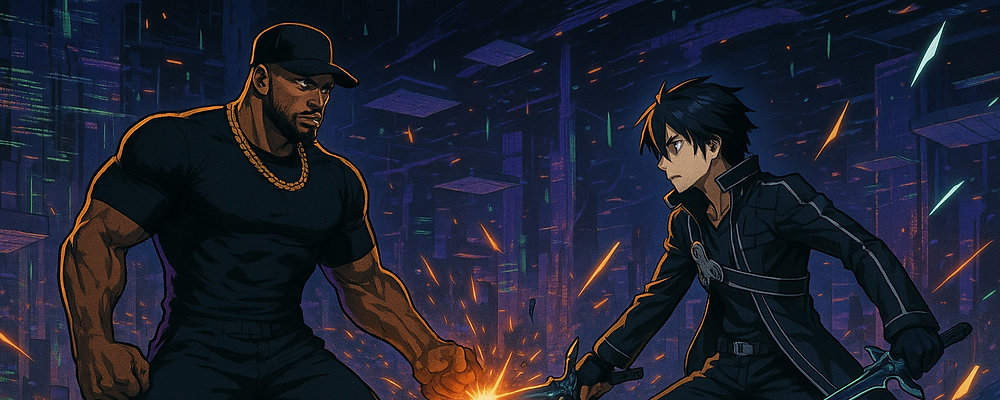
Before you read another word, answer these questions honestly:
-
What fantasy are you currently using to avoid building something real?
-
Where in your life have you substituted simulation for sovereignty?
-
How much of your identity is constructed from content you consume versus actions you execute?
-
When was the last time a story genuinely challenged you—not just entertained you?
-
What would change if you approached your development like your freedom depended on it?
Five years from now, when you look back at this moment, will you be grateful you chose reality over fantasy, or regretful you stayed plugged into someone else’s simulation?
What up world, Xavier Savage here from xperformancelab.com.
I’m about to bury the myth of Sword Art Online.
This ain’t revolutionary. It’s recycled. This ain’t deep. It’s derivative. This ain’t groundbreaking. It’s glorified fan fiction with a budget.
You were sold a lie dressed in digital armor. SAO is a hollow projection of male fantasy, privilege, and escapism masquerading as innovation.
Under the surface? It’s lazy, reductive, and borderline insulting to the very genres it mimics.
Your body is your first kingdom. Your attention is your first border wall. And SAO spent a decade breaching both.
Let’s cut it open.
XPL ENERGY TIER FRAMEWORK
| Level | Focus | Icon | Client State |
|---|---|---|---|
| Level I: Awareness | Exposure | 🪞 | “I didn’t know what I didn’t know” |
| Level II: Activation | Questioning | ⚡ | “Maybe what I’ve been watching isn’t working” |
| Level III: Execution | Deployment | 🛠️ | “I analyze regardless of popularity” |
| Level IV: Elite Mode | Mastery | 🔥 | “How can I extract 10% more from this critique?” |
| Level V: Peak Mastery | Integration | 🧠 | “Discernment is my default setting” |
This analysis is for Level III and Level IV readers. If you’re still defending SAO because it was your “first anime,” this cut ain’t for you yet. Come back when you’re ready to examine why you needed it.
XPL PERSPECTIVE FRAMEWORK
| Intensity | Icon | Purpose |
|---|---|---|
| 🔍 | Surface Scan | Quick observations |
| ⚡ | Deep Cut | Tactical analysis |
| 🔥 | Full Assault | Controversial takes |
| 💀 | Nuclear Option | Destroying sacred cows |
SWORD ART ONLINE RATING BREAKDOWN
Story/Plot Development: Level II: Activation (⚡⚡/5)
The premise carries weight: 10,000 players trapped in a VRMMORPG, death in game means death in real life. That’s existential horror with teeth.
Then the writers pulled every single one.
What could have been a meditation on identity, mortality, and the nature of consciousness becomes a harem power fantasy with occasional boss fights. The stakes exist only in dialogue, never in consequence. Characters die? Kirito mourns for exactly one episode. The game ends? There are four more seasons anyway.
XPL Performance Physics: Law 3—Systems Beat Intensity Over Time. SAO chose intensity (flashy fights, dramatic reveals) over systematic world-building. The result? A house built on sand.
Character Development: Level I: Awareness (🪞/5)
Kirito isn’t a character. He’s a self-insert algorithm with a sword.
Zero flaws that matter. Zero growth that sticks. Zero moments where he loses and learns instead of losing and unlocking a new ability. He starts the series as the Black Swordsman—god-tier, mysterious, desired. He ends it the same way, just with more women orbiting.
Asuna deserved better. She started as a co-leader, a fighter, a strategist. Then she fell in love and the writers put her in a cage—literally, sexually, narratively.
XPL Performance Physics: Law 2—Identity Precedes Outcome. Asuna’s identity was rewritten to serve Kirito’s arc. That’s not character development. That’s character demolition.
Animation/Fight Quality: Level III: Execution (🛠️🛠️🛠️/5)
Credit where it’s due: A-1 Pictures delivered visually. The fights are fluid, the character designs are distinct, the world of Aincrad has genuine visual weight.
But animation without stakes is just choreography. And choreography without consequence is just dance.
When Kirito dual-wields his way through every encounter, the spectacle loses meaning. You stop watching to see if he’ll win. You watch to see how fast.
That’s not tension. That’s a tech demo.
Overall Impact/Rewatchability: Level II: Activation (⚡⚡/5)
SAO’s impact is cultural, not artistic. It introduced millions to anime. It normalized isekai as a dominant genre. It proved that wish-fulfillment sells.
But rewatchability? Once you see the strings—the narrative shortcuts, the character inconsistencies, the moral laziness—you can’t unsee them.
This isn’t a show that rewards multiple viewings. It’s a show that collapses under scrutiny.
🔥 FULL ASSAULT: SAO IS .HACK BUT DUMBER
Before SAO, there was .hack//Sign.
Same premise: Virtual MMORPG. Same conflict: Trapped in the game. Same tone: Philosophical dread meets digital entrapment.
But where .hack explored identity, trauma, and consequence, SAO does what?
Levels up. Gets the girl. Beats the boss. Repeats.
.hack gave us Tsukasa—a protagonist who didn’t know if they wanted to exist, let alone escape. SAO gave us Kirito—a protagonist who never questioned whether he deserved to.
SAO stripped the soul out of a powerful idea and replaced it with wish-fulfillment. It turned existential horror into slice-of-life romance with a sword skin.
This ain’t evolution. It’s theft. But theft done wrong.
Because SAO copies the wrapper, not the core. No psychological depth. No narrative tension. No internal consequence.
XPL Performance Physics: Law 1—Energy Debt Compounds Faster Than Discipline. SAO borrowed energy from .hack, from Berserk, from every RPG its writers ever played. But it never paid that debt back with original insight. Eventually, the cultural account came due.
🔥 FULL ASSAULT: KIRITO IS THE WORST POWER FANTASY IN MODERN ANIME
Let’s talk about the main problem: Kirito.
He’s not a hero. He’s not a leader. He’s not a revolutionary.
He’s a wish-fulfillment algorithm with black hair and a trench coat.
No personality. No real flaws. No compelling trauma. No evolution.
He starts the series OP. He ends the series more OP. Everything in the middle? Irrelevant.
Kirito is the embodiment of the lonely man who wants to be admired without earning it, the gamer who wants to “own” women and enemies without developing social skills, the soft-spoken guy who wants to be feared for his “hidden” strength.
He’s the anime version of a dude who thinks wearing headphones in public makes him mysterious.
And the world bends around him. Every girl loves him. Every enemy respects him. Every system favors him.
That’s not a protagonist. That’s a glorified cheat code.
The writers never challenge Kirito because he ain’t there to grow. He’s there to let disconnected men project.
This is exactly the delusion over deployment mentality I break down in my training philosophy. All fantasy, zero execution. All simulation, zero sovereignty.
⚡ DEEP CUT: ASUNA WAS BUILT TO BE STRONG, THEN WRITTEN TO BE USELESS
You want to talk betrayal? Let’s talk about Asuna.
She started as independent, tactical, sharp, co-leader of a guild, respected among players, feared by enemies. She was the Flash to Kirito’s Batman—faster, sometimes sharper, absolutely essential.
Then what happened?
She falls in love. Gets sidelined. Gets kidnapped. Becomes a damsel in distress in a rape dungeon.
They took one of the few powerful women in anime—and wrote her into a literal cage.
No resistance. No revolt. No redemption. Just trauma and silence.
This wasn’t a plot twist. This was regression dressed as drama.
The message? You can be strong… until the hero arrives. Then sit down.
They made Asuna powerful so they could break her. That’s not storytelling. That’s entitlement with ink.
XPL Performance Physics: Law 6—Identity Contradiction Creates Homeostatic Resistance. Asuna’s identity contradicted itself—strong woman, helpless victim—and the narrative couldn’t resolve the tension. So it just… stopped trying.
This mirrors the toxic mindset I see in fitness culture—where women are celebrated for strength until that strength threatens male ego. That’s why I created specific training protocols that honor true power regardless of gender. Real strength doesn’t need anyone to shrink.
🔥 FULL ASSAULT: ESCAPISM AS ENTRAPMENT
Let’s be clear. SAO isn’t about virtual reality. It’s about emotional fantasy for disconnected men.
Men who don’t feel powerful in real life want a world they can control. Men who don’t want to confront their social failures want women who love without challenge. Men who fear consequence want conflict that never hurts.
What does SAO give them?
God-mode combat. Girls who orbit without effort. Enemies who lose without logic. A universe that needs them to survive.
It’s not fiction. It’s comfort porn.
This isn’t bad because it’s wish-fulfillment. Every story has elements of wish-fulfillment. It’s bad because it pretends to be deep.
Every arc claims stakes. But nothing ever hurts. Kirito dies? Just kidding. Asuna’s in danger? She’s waiting for him. New villain? Just cannon fodder for the next power-up.
Even the concept of death-in-the-game = death-in-real-life becomes meaningless because Kirito never truly risks anything.
He wins. Every time. Even in loss, he wins.
This is the exact nervous system dysfunction I address with clients—seeking comfort over growth, avoiding real challenge, choosing simulation over sovereignty.
💀 NUCLEAR OPTION: VILLAIN DESIGN IS LAZY AND VIOLENTLY OFFENSIVE
Let’s talk about the worst part of SAO: its villains.
They’re not just shallow. They’re violent caricatures.
Rape is a plot device. Mind control is used for romance. Entire arcs exist just to put women in cages.
Remember Sugou, the creep who literally licks Asuna’s face while she’s trapped? What was the point?
Shock value. Viewer rage. Power reinforcement for Kirito.
When the villain is pure evil, the hero doesn’t need depth. It’s shortcut morality.
No moral ambiguity. No ethical complexity. No recognition that real villains are rarely mustache-twirling monsters—they’re systems, structures, and sometimes, ourselves.
This is dangerous storytelling. It teaches the audience that enemies are irredeemable, women are objects to be saved, power is earned by being “not evil.”
That’s not a hero’s journey. That’s digital fascism.
⚡ DEEP CUT: SAO AS A TECH BRO’S WET DREAM
Let’s zoom out. SAO is what tech billionaires think the world should be.
A simulation where they can control the systems. Build rules they never follow. Be praised for exploits. Have AI girlfriends. Be “needed” by fake societies.
Kirito is Elon Musk with a sword. Mark Zuckerberg with better hair.
They see themselves in him: misunderstood, superior, desired, alone but noble.
It’s digital savior syndrome wrapped in VR.
You wonder why men with power love anime like this? Because it’s ego validation without spiritual cost.
No challenge. No reflection. No contradiction. Just a mirror.
This connects to what I teach about true strength versus ego—real power requires vulnerability and growth. Real sovereignty requires unplugging from systems designed to flatter you.
🔥 FULL ASSAULT: HOW THIS HURTS THE CULTURE
When Black and Brown youth watch SAO, they’re invited in by aesthetics—action, romance, survival, the promise that anyone can be the hero.
But they’re excluded by design.
No ethnic characters in meaningful roles. No culture explored beyond the Japanese coder-bro lens. No systemic commentary, even though the premise—10,000 people trapped by a corporation—demands it.
What could this story have done?
Explored PTSD from digital trauma. Showed class disparity in tech access. Examined how wealth transfers into virtual worlds. Talked about labor and exploitation in the gaming economy. Centered women, not just displayed them.
But it didn’t. It chose the easiest path: Self-insert + Violence + Harem.
That ain’t storytelling. That’s glorified Tinder with swords.
This is why I emphasize sovereignty over simulation in everything I teach. If the stories you consume don’t reflect the fullness of human experience, they’re not expanding you. They’re shrinking you.
🔍 SURFACE SCAN: OTHER SHOWS DID IT BETTER
Want real virtual worlds? Watch:
Log Horizon — Strategy, politics, identity, and what happens when gamers become citizens instead of just fighters.
.hack//Sign — Trauma, memory, dissociation, and the question of whether you want to return to a body that betrayed you.
Psycho-Pass — State control, surveillance, rebellion, and the price of safety.
Eden of the East — Power, collective responsibility, and what one person owes the society that raised them.
Zetman — What happens when you’re born broken, but choose sovereignty anyway.
These shows challenge you. They don’t pander to you. They show loss, love, trauma, and truth.
SAO? It shows you a man with plot armor and a sword who never has to ask himself the hard questions.
THE SAVAGE VERDICT
Sword Art Online isn’t an anime. It’s an emotional life raft for men who never healed.
It’s a mirror for insecure ambition. It’s a shrine to safety.
Kirito never really bleeds. Asuna never really resists. The world never really punishes.
This is not a tale of courage. It’s not about innovation. It’s not even about love. It’s about control.
SAO teaches you to crave power, not peace. To admire strength, not sacrifice. To simulate life, not build one.
That’s the real tragedy. Not that it’s overrated, but that so many men think this is the apex.
You want power? Learn pain. Learn loss. Learn who you are without a sword.
That’s where the real game begins.
THE MASTERY SYMBOLS
🔗 The Chain: Your choices connect to your consequences. Every hour spent in simulation is an hour stolen from sovereignty. SAO’s characters faced no real chains. Yours are real. Feel them.
🪞 The Mirror: When you watch Kirito glide through Aincrad without earning his growth, do you see your own desire for success without sacrifice? The mirror doesn’t lie.
👑 The Throne: How will you develop real capability instead of relying on fantasy? The throne doesn’t negotiate.
IDENTITY MIRROR QUESTIONS
-
What fantasy am I currently using to avoid building real strength?
-
Where in my life have I substituted consumption for creation?
-
When did I last truly risk something—emotionally, physically, professionally?
-
Who am I when no one’s watching and no system is rewarding me?
-
What would I attempt if I couldn’t fail—and what does that answer reveal about my current fears?
ACTION TRIGGER QUESTIONS
-
What one screen-based escape will I reduce or eliminate this week?
-
Where will I invest that recovered time into physical development?
-
Who in my life needs me present, not plugged in?
-
What real-world challenge have I been avoiding that I’ll confront in the next 24 hours?
-
How will I measure my sovereignty this month—not my entertainment consumption?
RESOURCE DROP
Follow my daily insights on Instagram @xperformancelab and YouTube @xperformancelab.
For those in Houston demanding the highest level of training, in-person sessions are available at VFit Gym, 5535 Richmond Ave, Houston, TX.
Elite online training systems at xperformancelab.com.
Take the Archetype Quiz to discover your specific body type protocol: xperformancelab.com/quiz
📊 SEO OPTIMIZATION DATA
Meta Description (155 chars max):
Xavier Savage from XPerformanceLab dismantles Sword Art Online—exposing why this “masterpiece” is actually hollow wish-fulfillment that trains viewers for fantasy, not sovereignty.
URL Slug:
sword-art-online-review-cultural-critique-xavier-savage
Primary Keyword:
Sword Art Online review
Secondary Keywords:
SAO critique, Kirito character analysis, isekai problems, anime masculinity, virtual reality anime, XPerformanceLab
Target Search Intent:
Informational
🖼️ IMAGE OPTIMIZATION GUIDE
Featured Image:
-
File Name: xavier-savage-sword-art-online-review-xpl-featured.jpg
-
Alt Text: “Xavier Savage analyzing Sword Art Online at XPerformanceLab”
-
Dimensions: 1200x630px minimum
🎨 MIDJOURNEY VISUAL PROMPTS
Prompt 1: Kirito Deconstruction
/imagine A lone samurai standing in a futuristic dojo surrounded by broken mirrors — each mirror reflects a different version of himself — none of them real — cinematic lighting — dark atmospheric tones — 4k — ar 16:9 — style raw –v 6
Prompt 2: Asuna’s Cage
/imagine A warrior woman trapped inside a glowing digital cage — her hand reaches through the bars — outside the cage lies a battlefield she should be fighting on — emotional — blue and gold contrast — ar 16:9 — style raw –v 6
Prompt 3: Simulation vs. Sovereignty
/imagine Split composition — left side man wearing VR headset smiling in darkness — right side same man shirtless lifting a heavy barbell in sunlight — sweat dripping — real vs fantasy — ar 16:9 — style raw –v 6
📚 SCIENTIFIC REFERENCES
-
Valkenburg, P. M., & Peter, J. (2013). “The Differential Susceptibility to Media Effects Model.” Journal of Communication, 63(2), 221-243. https://doi.org/10.1111/jcom.12024 — Supports: Media consumption shapes identity formation, particularly in adolescent and young adult males.
-
Przybylski, A. K., Weinstein, N., Murayama, K., Lynch, M. F., & Ryan, R. M. (2012). “The ideal self at play: The appeal of video games that let you be all you can be.” Psychological Science, 23(1), 69-76. https://doi.org/10.1177/0956797611418676 — Supports: Wish-fulfillment narratives appeal most strongly to individuals experiencing gaps between actual and ideal selves.
-
Anderson, C. A., et al. (2010). “Violent video game effects on aggression, empathy, and prosocial behavior in Eastern and Western countries.” Psychological Bulletin, 136(2), 151-173. https://doi.org/10.1037/a0018251 — Supports: Media that frames violence as consequence-free can reduce empathy over time.
-
Turkle, S. (2011). Alone Together: Why We Expect More from Technology and Less from Each Other. Basic Books. — Supports: Simulation culture replaces authentic connection with controlled digital experiences.
🔗 INTERNAL LINKING STRATEGY
-
Anchor Text: “delusion over deployment mentality”
-
Target: https://www.xperformancelab.com/post/energy-management-framework
-
Purpose: Connect fantasy critique to practical energy management system
-
-
Anchor Text: “training protocols that honor true power regardless of gender”
-
Purpose: Guide readers toward personalized training approach
-
Anchor Text: “sovereignty over simulation”
-
Target: https://www.xperformancelab.com/post/inertia-over-inspiration-manifesto
-
Purpose: Deepen philosophical framework for new readers
-
-
Anchor Text: “nervous system dysfunction”
-
Target: https://www.xperformancelab.com/post/recovery-drives-adaptation
-
Purpose: Connect media critique to physical recovery protocols
-
Execute.
The mirror showed you something today. What you do with the reflection is your move.
Scroll to unlock levels
Level V Achieved
Now live it.
Unlocked
Leave a Reply