How Many Carbs Should You Eat? A Houston Trainer’s Carbohydrate Guide
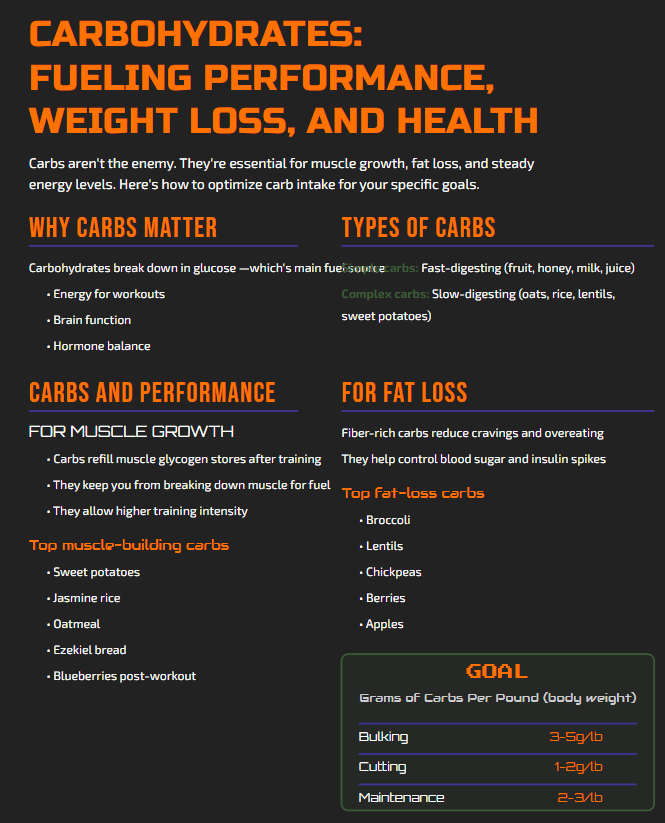
For most of my clients, carbs land around 1.5 grams per pound of body weight when cutting, about 2 grams per pound at maintenance, and up to 3.5 grams per pound during an aggressive bulk with high training volume. Pick mostly whole-food carbs and time more of them around workouts. Carbs are fuel, not the enemy.
Who is this guide for?
I am Zavier King, owner of XPL. I train clients in person at V-Fit Gym, 5535 Richmond Ave near the Galleria in Houston, and I coach people online. Carbs are the topic I get asked about most, so this is how I explain them to the people I train.
The numbers below are starting points. Your size, training load and how your body responds will shift them.
What do carbs actually do for your body?
- Fuel training. Carbs are your body’s main fuel for hard, high-intensity work like lifting and sprinting.
- Refill your tank. Carbs restore glycogen, the stored energy in your muscles, after training (Kerksick et al., 2017).
- Support recovery. Pairing carbs with protein after training helps you recover and get ready for the next session.
- Keep you sharp. Long Houston workdays plus training take energy. Carbs help you avoid running on empty.
Sports nutrition guidelines from the American College of Sports Medicine and dietitian groups recommend scaling carbs to how much you train, from lower intakes on light days to much higher intakes for athletes training several hours a day (Thomas et al., 2016).
Which carbs should you eat?
I split carbs into two simple groups.
Faster-digesting carbs, best before or after training:
- Bananas and berries
- Honey
- Dairy like milk and yogurt
- White rice or rice cakes
Slower-digesting carbs, for steady energy through the day:
- Steel-cut or rolled oats
- Jasmine, brown and wild rice
- Lentils and beans
- Sweet potatoes
How many carbs should you eat for your goal?
Use your current body weight as a baseline:
- Cutting: about 1.3 to 1.5 grams per pound
- Maintenance: about 2 grams per pound
- Bulking with high training volume: about 2.5 to 3.5 grams per pound
If you train lightly, stay at the lower end. If you train hard 5 or 6 days a week, you can go higher. Adjust every 2 weeks based on your weight trend and how your workouts feel.
What does a bulking day look like?
Example: a 190 pound man training hard and aiming for 210 pounds.
- Carbs: about 3.5 grams per pound, roughly 665 grams a day
- Calories: about 3,800 to 4,000 a day
Sample day:
- Breakfast: eggs, Ezekiel toast, banana and almond butter
- Mid-morning: chicken, jasmine rice and broccoli
- Lunch: oatmeal with whey protein and blueberries
- Pre-workout: rice cakes, whey isolate and peanut butter
- Post-workout: steak, white rice and spinach
- Evening: Greek yogurt, granola and honey
My go-to muscle-building carbs are jasmine rice, Ezekiel bread, oats, sweet potatoes and berries after training.
What does a cutting day look like?
Example: a 240 pound man aiming for 210 pounds.
- Carbs: about 315 to 350 grams a day
- Calories: about 2,400 to 2,600 a day
Sample day:
- Breakfast: eggs, spinach and sprouted grain toast
- Mid-morning: turkey, quinoa and greens
- Lunch: protein shake and an apple
- Pre-workout: rice cake with almond butter
- Post-workout: salmon, jasmine rice and zucchini
- Evening: cottage cheese and berries
When clients cut with me, I do not remove carbs. I structure them. High-fiber carbs keep hunger down, and timing most of them around training keeps workouts strong. My favorite cutting carbs are broccoli, kale, lentils, chickpeas, berries and apples.
What does a maintenance day look like?
Example: a 210 pound man holding steady.
- Carbs: about 2 grams per pound, roughly 420 grams a day
- Calories: about 3,000 a day
Sample day:
- Breakfast: egg omelet and Ezekiel toast
- Mid-morning: smoothie with oats, banana and almond butter
- Lunch: lean beef, brown rice and asparagus
- Afternoon: Greek yogurt, granola and berries
- Post-workout: chicken, white rice and green beans
- Evening: cottage cheese and a spoon of peanut butter
Do men and women need different carb strategies?
The basic rules are the same. A few patterns I notice with clients:
- Many of my male clients do well with a bigger share of their carbs after training.
- Many of my female clients do better with carbs spread more evenly through the day, often with more fiber and slightly lower totals.
- Some women find slower-digesting carbs like oats, quinoa and lentils help with cravings in the days before their period.
These are coaching observations, not rules. Track how you feel and adjust.
What about carbs during pregnancy?
I never recommend very low-carb diets during pregnancy. I lean on whole-food carbs like sweet potatoes, fruit, legumes and oats, with regular meals to keep energy steady. Always work out your nutrition plan with your doctor or a registered dietitian.
Which carb myths should you stop believing?
- “Carbs make you fat.” Eating more calories than you burn makes you gain fat, whatever the source.
- “Fruit is nothing but sugar.” Whole fruit comes with fiber, water and nutrients.
- “All carbs are the same.” Oats and a pastry are not the same food.
- “Low carb is the only way to lose weight.” It is one option, not the only one.
For the science behind how carbs are used, read the secret behind how carbohydrates work and how runners use carbs to fuel themselves. For the full plate, see my no-nonsense nutrition guide.
How can you train with me in Houston?
I coach athletes, professionals and parents who want their nutrition to work with their training. If you are in Houston, you can train with me in person at V-Fit Gym, 5535 Richmond Ave. If you are elsewhere, I coach online.
Take the XPL quiz to get started, then see my services and pricing, or contact me with questions.
Scroll to unlock levels
Level V Achieved
Now live it.
Unlocked
Frequently asked questions
How many carbs should I eat to lose fat?
Most of my clients start around 1.3 to 1.5 grams per pound of body weight while cutting, then adjust based on progress and energy.
Are carbs bad at night?
No. Total intake across the day matters more than the clock. Many people sleep better with some carbs at dinner.
What are the best carbs before a workout?
Easy-to-digest options like a banana, rice cakes or oatmeal 1 to 3 hours before training.
Do I need carbs to build muscle?
You can build muscle on lower carbs, but most people train harder and recover better with enough of them, especially during a bulk. Written by Zavier King, personal trainer in Houston and online coach at XPL. ISSA Certified Personal Trainer and NASM Nutrition Coach. This article is general education, not medical advice.

Zavier King
Founder, XPERFORMANCELAB
I do not shape muscle. I shape structure. The person you become is the person you construct.
Related Insights
Why Zinc Is Essential: What It Does, How Much You Need and Best Sources
What does zinc do? It supports immunity, healing, protein building and hormones. Men need 11 mg a day, women 8 mg. Here are the best food sources.
Why Is the Deadlift the Best Lift, and How Should You Breathe for It?
The deadlift trains your back side, grip and core in one lift. Brace with a 360 degree breath before each rep. How I teach it, and when to…
Important Foods for Better Gut Health (and What to Limit)
What foods improve gut health? Fermented foods, fiber-rich plants, nuts, seeds and berries help most, while alcohol and ultra-processed foods hurt.